

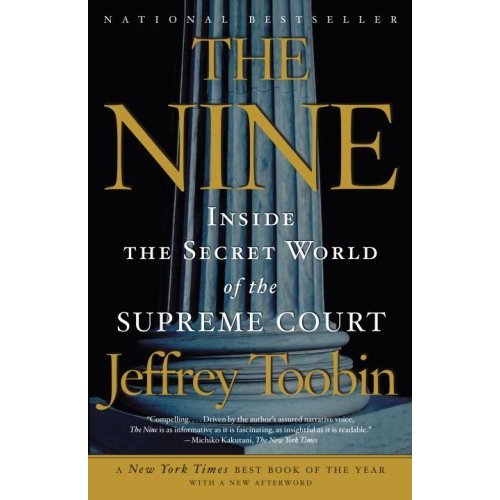
 I'm way behind on my pleasure reading, so it’s only been in recent weeks that I have read Jeffrey Toobin’s book, “The Nine: Inside the Secret World of the Supreme Court.” The book is written in a manner that will appeal to lawyers and non-lawyers alike. Toobin deftly handles the challenge of introducing and discussing some of the most significant constitutional cases in recent years without getting bogged down in legal mumbo-jumbo. And the book is replete with many entertaining anecdotes about various personalities. (Very little about the UCC, though. But I'm over my disappointment.)
As I read through the book, I kept notes of some of the more memorable lines, six of which I’ll quote:
At an appearance at a New York synagogue in 2005, Scalia was asked to compare his own judicial philosophy with that of [Clarence] Thomas. “I am an originalist,” Scalia said, “but I am not a nut.” (103)
It was clear by this point that Scalia didn’t need better arguments to win over his colleagues; what he needed was different colleagues. (124)
Kennedy’s vanity was generally harmless, almost charming — sort of like the carpet in his office. (147)
Ashcroft, the former Missouri senator whom Bush named his first attorney general, embodied everything that O’Connor disdained about the modern Republican Party. He was extreme, polarizing, and moralistic — unattractive. (205)
At first it was the legacy of Bush v. Gore that turned O’Connor and Kennedy toward their more liberal colleagues. Later, it was the Bush administration itself. (227)
I had one more passage I intended to quote, but I noticed it got dropped somewhere along the line (appearing in the galleys, which I read, but not appearing in the final publication). The passage was (in my opinion) somewhat scathing, so I’ll always wonder if the remarks were dropped at the suggestion or insistence of the publisher and/or further reflection of the author.
For substantive remarks on the book, readers may wish to read Georgia State law professor Eric Segall's review at 58 Journal of Legal Education 463-71 (2008).