

 From the Washington
Post:
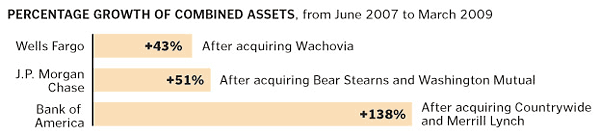
The crisis may be turning out very well
for many of the behemoths that dominate U.S. finance. A series of federally
arranged mergers safely landed troubled banks on the decks of more stable
firms. And it allowed the survivors to emerge from the turmoil with
strengthened market positions, giving them even greater control over consumer
lending and more potential to profit.
. . .
Officials waived long-standing
regulations to make the deals work. J.P. Morgan Chase, Bank of America and
Wells Fargo were each allowed to hold more than 10 percent of the nation's
deposits despite a rule barring such a practice. In several metropolitan
regions, these banks were permitted to take market share beyond what the
Department of Justice's antitrust guidelines typically allow, Federal Reserve
documents show.
. . .
Large banks with more than $100 billion
in assets are borrowing at interest rates 0.34 percentage points lower than the
rest of the industry. Back in 2007, that advantage was only 0.08 percentage
points, according to the FDIC.
The article discusses
in some detail two concerns stemming from banking industry concentration: lack
of consumer choice and moral hazard.
The Wall
Street Journal tells a similar tale in Halting
Recovery Divides America in Two:
The U.S. recovery is a tale of two
economies.
At one extreme of Corporate America is
a cadre of companies and banks, mostly big, united by an enviable access to
credit. At the other end are firms, chiefly small, with slumping sales that
can't borrow or are facing stiff terms to do so.
Meanwhile,
on Friday, three more banks demonstrated that they are not too big to fail. Bradford Bank,
Baltimore, Maryland; Mainstreet Bank,
Forest Lake, Minnesota; and Affinity Bank,
Ventura, California were all closed by the FDIC, bringing the total for the
year to 84. See here
for the FDIC's full list of failed banks since October 1, 2000.
Related Posts:
Failures,
Funds, and the FDIC
Bank
Failures and FDIC Fund Losses
Bank Failures Update and Future Problem Banks
Bank Failures in Historical Perspective