

 In response to Eric’s
post on workshop culture (which, in turn, is partially a response to my
prior post on workshops) Glenn Cohen provides some very interesting
comments. So I thought that
I’d bring them to the front, and elaborate on them somewhat, in the hopes of
continuing this conversation. In
particular, I wanted to focus on three points raised by Glenn, some of which
are also raised by Mike Madison and Jacqui Lipton in their comments: junior
faculty workshops, specialized/interdisciplinary workshops, and workshop
format.
1. Junior Faculty Workshop Series. I’ve never been at a school that had a
workshop limited to junior faculty (as opposed to a junior faculty exchange,
such as that mentioned
by Jacqui), but a friend who was a junior faculty member at UCLA remembers
them quite fondly there. I assume
that this requires some critical mass of junior faculty, so maybe it’s not an
option at smaller schools, or at those with few juniors. For those of you who’ve experimented
with these at your schools, are they successful (as it sounds like they have
been at Harvard and UCLA)? How is
“junior” defined? All untenured
faculty? Are VAPs and fellows included? Although I know it seems obvious, it actually
has never been obvious to me: what exactly is the rationale for limiting these
workshops to the junior folks?
Performance anxiety with respect to senior folks who’ll be deciding your
future? A reluctance to show
vulnerability in front of senior faculty if you think you’ll be judged on
something still half-baked? Building
camaraderie among the junior cohort?
2. Specialized/Interdisciplinary Workshop
Series. I’ve seen two schools of thought on this. Some folks are negatively inclined toward specialized series
on a few theories:
(a) It causes faculties to become even more specialized and
isolated by subject matter, rather than forcing them to interact, learn from
each other, and become more cohesive;
(b) People are already overloaded with work, especially
during appointments season, so the specialized series may pull people away from
the primary series; and
(c) Cross-departmental workshops, in particular, may
struggle with big differences in workshop norms. For example, some departments may read their papers, rather
than “presenting” them. Some
fields may immediately start arguing about the model without ever getting to
the points of the paper on which the bulk of a law audience might have useful
input. The norm in some
departments or fields may be to interrupt whenever you feel like it, whereas
some departments or fields prefer to keep a list and proceed through it an
orderly manner. The norm in some
departments or fields is to never look at the paper in advance, whereas in
others the expectation is that people will read carefully.
Despite these potential issues, I’ve always liked
specialized workshop series, especially those that bring together people from
different departments. We have two
that I attend: a Law & Finance series (with Fuqua) and a Law & Social
Science series (primarily with political science, but including other social
sciences as well). To me, the
strongest argument in favor of these workshops is the chance to meet, interact,
and learn from colleagues in other disciplines in ways that wouldn’t likely
happen otherwise. Especially if
you can maintain the series over the course of a few years, it seems to me, there’s
a real opportunity for relationship-building and potential collaboration across
departments – though, admittedly, I’m a glass-half-full type of person. Perhaps
these possibilities only rarely, if ever, come to fruition?
3. Workshop Format. Mike
points out in his comments that the room layout and furniture arrangement
can have a big impact on workshop dynamics. I’ve noticed this as well, and am always surprised when
little, if any, thought appears to have gone into this aspect of the
workshop. Of course, many schools
are space-constrained, particularly when it comes to smaller rooms, so often we
just make do with what we have. But
the other thing that really impacts workshop dynamics, it seems to me, are the
norms and arrangements with respect to presentation, questioning, and reading
the paper. On presentation, I’ve
seen, or heard of, at least four variations (readers should feel free to add
more):
(1) Short presentation by the speaker – time limits strictly
observed, the norm is that people have read the paper, so little is required in
the way of introduction.
(2) Long (occasionally interminable) presentation by the
speaker – time limits are loosely observed, if at all. Often this is because many in the
audience have not read.
(3) No presentation at all – people just start asking
questions right off the bat. (Or, the speaker is theoretically entitled to
present, but is immediately interrupted, making it about the same as no
presentation)
(4) Commenter followed by author response. The author does not present her paper,
but instead is allowed to respond for a few minutes after someone else
presents/comments on her paper.
Again, in my experience, the expectation is that most of the audience is
familiar with the paper, thus no formal presentation of the material is
necessary, and most of the “presentation” is focused on critique.
I’m quite partial to option four – commenter followed by
author response – which we implemented at Duke this year, though I’m
comfortable with three and one, as well. I like the commenter format as an author because it almost
always ensures that you get really careful input from at least one person. Plus, it takes the pressure of
the more performative segment of the workshop away from me and puts it onto
someone else (the commenter). As
an audience member I also like this format, because I feel like I get to hear a
detailed reaction and critique from someone else of a paper that I also just
read and thought about. I almost
always find the commentary interesting and helpful, even as a consumer of the
paper, rather than the author.
Having said all of that, I know that some people disfavor
the commenter format. Their concern,
normally, is that having two people speak rather than one leaves less time for
questions. And if either one or
both of the commenter or author don’t plan their talk well and fail to follow
time limits, then you’ve really got very little Q&A going on. And, of course, from the author’s
perspective, a bad commenter may just seem a waste of your limited workshop
time.
Last, but not least, I should mention food. When it’s crappy and inedible, is that
a good signal (as in, “we’re here for the paper, not for the food”) or a bad
one (as in, “our financial situation is worse than we've suggested in that glossy law porn we send out, and we wouldn’t spend our
limited resources on workshops anyway”)?
As I write this, a third – and infinitely more horrific – option occurred
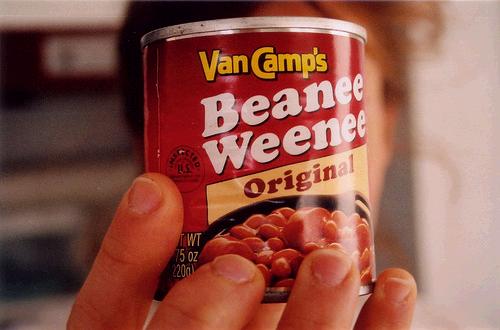
to me: the “we eat this because we actually think that Beanee
Weenie on Wonder Bread tastes good” possibility. If it’s a job talk, you should probably run. Otherwise, call Steve
Bainbridge for wine recommendations, and drink large quantities.

Well, I’ve rambled on long enough now. I’ll open this up to comments, and
hopefully others will chime in with their own preferences, dislikes, and horror
stories (if the latter, do try to include place and person names – I’m getting
bored at the end of the break.)
Bad food is a bad sign. Inedible food will drive me away from a workshop. Then again, I'm pretty much to the stage where I'll have a market-based solution to this (you'll like this, Kim) — getting my own food and bringing it to workshops.
There's a positive correlation, I believe, between quality of food at a job talk and how faculty assess the talk, or so it appeared to me when I did a job talk at Alabama back in 2000:
http://www.thefacultylounge.org/2008/11/my-life-with-barbeque.html
Based on that theory, Al, it might be worth the money to cater one's own job talk lunches. If it's a position you really want, bring on the lobster and caviar!
This likely goes without saying, but the more people who have actually read the paper before the talk, the better the exchange of ideas. If few have read the draft, workshops become more an exercise in performance and public speaking.
I like the idea of option 4 (a discussant) best too, but perhaps with instructions to that person to keep it brief – or to frame the comments as issues for the audience to discuss.
Here is another question: what makes for good conference panel formats?
Hi Erik — welcome back from New Orleans. I enjoyed your posts over at the Glom on the financial regulation panels. I agree with you about the importance of reading the paper, and an interesting question is how workshops can be structured to help foster that norm. My post was too long already and so I deleted that part. But I think that's another argument in favor of the commenter format — it sends a signal about reading expectations. I know that some schools also try to limit the length of papers, so that faculty aren't over-burdened with long papers. For internal workshops, some also try to push "early stages" workshops, where the papers are, by definition, shorter, to try to reduce the workload. If readers have seen other mechanisms that work on this front, feel free to share.
On the conference question, that's much harder, I think. Maybe I'll do a conference format post soon if I have time . . .