

 As everyone not living under a rock is probably aware, the
new Michael Lewis book, The Big Short:
Inside the Doomsday Machine, is now available. My financial
crisis reading group students are gearing up to read and discuss this at
our last class meeting in a few weeks.
The group unanimously voted to read The
Big Short for our last class. (I understand that Brad
Pitt’s involvement was a not irrelevant consideration in the decision.)
I’m sure I’ll be back with more on the book once I’ve had a
chance to read it, but Monday’s
Dealbook brings an interesting bit of
information: in the acknowledgements, Lewis recognizes “A.K. Barnett-Hart, a
Harvard undergraduate who had just written
a thesis about the market for subprime mortgage-backed CDOs that remains
more interesting than any single piece of Wall Street research on the subject.” (HT: Rolfe Winkler)
Barnett-Hart, pictured below left, is now a 24-year-old
financial analyst at a large New York investment bank. Her thesis, The
Story of the CDO Market Meltdown: An Empirical Analysis (dated March 19,
2009, a year ago yesterday), “was awarded summa cum laude and won virtually
every thesis honor, including the Harvard Hoopes Prize for outstanding
scholarly work.”
 Using hand-collected data from 735 ABS CDO’s, Barnett-Hart
draws three main findings on the adverse performance of CDOs:
First, the properties of the CDO collateral, including asset
class and vintage, are the most important factor in explaining the variation in
CDO performance. In particular, CDOs with a high level of exposure to
residential mortgage securities, specifically those backed by subprime and
Alt-A adjustable-rate mortgages, consistently underperformed other CDOs. In
addition, losses were higher for CDOs with a large amount of 2006 and 2007
vintage collateral. Secondly, the identity of the CDO underwriter is a
significant predictor for CDO performance, even after controlling for
collateral type. This finding shows that there was variation among banks’
underwriting standards, with some banks consistently more careful in their
collateral selection. For example, J.P. Morgan’s CDOs consistently
underperformed, while those from Goldman Sachs were among the top performers.
Lastly, the original credit ratings assigned to CDOs failed to capture the true
risks of these securities. There was a striking uniformity in the initial
proportion of AAA given to all CDO deals, despite the wide variety in the
characteristics of their collateral and the quality of their underwriters. On
the whole, the original credit ratings of CDO bonds, most notably those given
to the senior tranches, were grossly inflated.
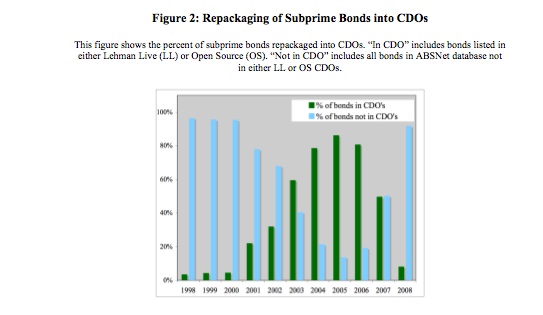 Also striking is Figure 2 from the thesis, at right, which shows
the percentage of subprime bonds that were repackaged into CDOs. Notice the increase and subsequent
crash, with the peak in 2005.
As someone who attended a large state university, rather
than an undergraduate institution where this type of senior thesis work (and
the accompanying faculty oversight and interaction) was expected, I’m
fascinated by the quality of some of this research. Some readers may remember Emily Glassberg Sands (Princeton,
’09), who developed an experimental survey to test whether scripts attributed
to male authors were better received than those attributed to female authors
and found substantial gender bias in quality ratings. (Sands sent identical scripts written by
prominent female playwrights but labeled with gender-specific pen names — Mary
Walker versus Michael Walker, for instance — to artistic directors and theater
managers.)
 As reported in the Princeton
Alumni Weekly:
Sands' data showed that women reviewers were responsible for
the bias against women. Specifically, women reading plays by women assigned
lower ratings on questions about whether the characters were likable and how
likely it would be that the playwright would win a prize.
But Sands noted that factors beyond gender discrimination by women could explain the findings:
The relatively few women who are artistic directors and
theater managers, Sands said, "are definitely the outsiders, and as
outsiders, they are probably trying to make the safe bet. In general, the safe
bet is usually a work by a man because historically, it's been more widely
accepted in the theater community. … Once I looked more into the literature,
I realized that [the apparent bias is] not quite as much of an anomaly as it
sounds."
Sands’
work also
received attention from media outlets, including The New York Times, National Public Radio, and Bloomberg. That gives even a Michael Lewis book and Brad Pitt movie a
run for the money.