

 Thirty-five year old James Bruce came home to the University of North Carolina to deliver an address in June 1841. Bruce had graduated in 1825 and returned to Hallifax County, Virginia to tend to his family's businesses — as merchants and as planters. Bruce was by 1841 in the midst of making one of the great fortunes in the old South, built largely on trade, though also on enslaved human labor.
But Bruce's address was not the typical proslavery jeremiad. There were plenty of those at antebellum colleges — just not at UNC. For a good example of this, you might turn to the University of Virginia, where law professor James Holcombe delivered a lengthy speech that touched on the connections between education and slavery in 1853. Or to the University of Alabama, where Edward Bullock spoke in 1858 of the need for slavery — or Joseph Wright Taylor.
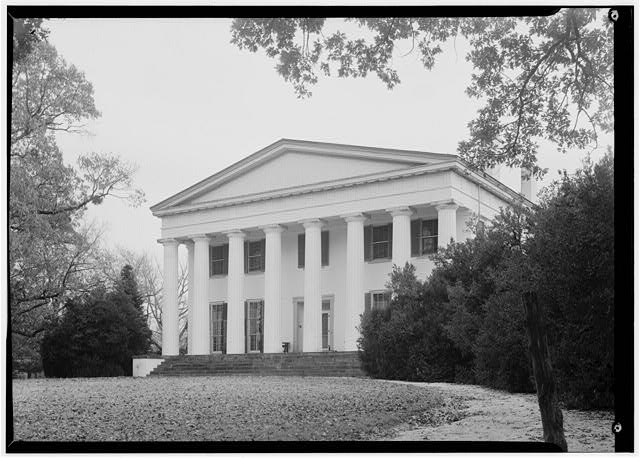
Later in life, Bruce built one of the great antebellum mansions — Berryhill. The image, taken by the Historic Building Survey, is at right. (Want to see it today? It's a resort.) He had already appeared in the Virginia legislature and voted against a gradual abolition plan during the legislature's 1832 debate. Yet on the eve of Civil War, Bruce was a member of the Virginia Colonization Society — and thus a supporter of at least some gradual, maybe imperceptible, emancipation plan.
Bruce was shrewd observer of contemporary America. While scholars are still talking about the divisions between oratory and print — and how oratory in early American played on the audience's passions while print appealed to their calculating reason — Bruce perceived a convergence of the rhetoric in oratory and print, since speeches were so frequently set down to print and then conveyed across space to reach a much broader audience than any who would hear it. "Any effort to rouse the passions, or touch the heart, at once excites jealousy and distrust," Bruce said. "Liberty and patriotism are no longer sentiments, at the bare mention of which, the heart vibrates along every chord, but things to be reasoned of, weighed, measured, and calculated, with the same coolness that we estimate the blessings of steam, or the value of the spinning jenny."
Like a lot of extremely wealthy (and powerful) people, his address wandered in some pretty interesting and unusual directions. He spoke of how the years away from college had changed how alumni viewed the school. If one spoke of those changes in terms of a picture, Bruce thought
What a wonderful and diversified mingling there would be, of light and shade! Still the objects painted are always the same, the difference of coloring depending altogether on the variant positions of each canvass. To the gloomy, the light would be as dark as that which steals through the stained glass of a Gothic window, to the light hearted and joyous, it would dance and dazzle as through a crystal prism, while to him who dwelt in the temperate zone of subdued and sober, yet gladsome feeling, the world would appear, as it is, something to weep over and rejoice at, with hills of elevation and plains of depression, firm ground and morasses, arid prospects and enchanting views–in short neither all good nor all bad.
And Bruce, like many, many orations of his age, celebrated technological progress–especially the steam engine:
The triumphs of the Steam Engine are, indeed, among the sublimest results of Natural Science. By its almost omnipotent power, time and space are annihilated, and the most distant parts of the world brought nigh. Before the magic power of Steam, even the ocean has dwindled from its once grand extent, and is now but another Firth of Forth, dividing us from our brethren of the old world. The operations of the Steam Engine are as diverse as they are magnificent and impressive. Mighty as it is in power, it spurns no labor whatsoever. It weaves our stocking and gloves, it makes our pins and needles, it digs our wells, saws our timber, hews our granite, refines our sugar, prepares our pens, cooks our food, washes our clothes, and, in short, performs for us, at once, the most imposing and the most trivial services.
And — also like many orators — he celebrated the political theory of our Revolution, the ways in which the United States had brought into being a world so, so different from that of Europe. Of how — linking technological and political change – Franklin wrested the lightening from the heavens and the scepters from tyrannts.
The honor of first reducing to successful practice what was before deemed a Utopian dream, and of demonstrating that the people themselves are their best rulers, is all our own. We alone have carried out the great Church reform which Martin Luther commenced, by breaking up the unholy connection between the priest and the politician – we alone have no aristocracy but what God and man’s own merit have made – have no armed soldiery to imbue their hands in the blood of their brethren – no sinecures – no bloated wealth – no squalid poverty.
Bruce was concerned about many things, including economic development. Right now, though, I'm interested in Bruce's ideas of jurisprudence and philosophy. He opposed the narrow construction of federal powers regarding internal improvements. He had a particular theory of constitutional interpretation.
It is high time that the South was giving up its old prejudices and antiquated modes of thinking – that it was breaking the ties which unite it to a departed age, and bind together the living and the dead. Our ancestors used the lights of their age, why should we reject the brighter ones of our own? They ran ahead of their times, why should we lag behind ours? They were dissatisfied with their condition, and improved it, let us do likewise; they were wise in their generation, let us be wise in ours.
That's an extraordinary appeal — not unique, for liberal Whigs frequently battled Democrats and more conservative Whigs for a broader reading of the Constitution. But Bruce's appeal to the new lights of the modern age was at the edge of what was acceptable. It began to run the risk of sounding like Thomas Paine, whose reputation at this point was tarnished by his association with the French Revolution.
Want to read Bruce's address? Here it is, available no where else on the net, so far as I can determine. Even the extraordinary books.google project hasn't reached it yet! Here is Bruce's 1840 address to University of Virginia alumni, another address available no where else on the net.
Coming up shortly: The image of the book in the antebellum mind.
Update as of July 19: Here's my paper, "The Republics of Liberty and Letters: Progress, Union, and Constitutionalism in Graduation Addresses at the Antebellum University of North Carolina," which is now up on ssrn.