

 Sticking my head up from working on University, Court, and Slave for a moment to bring you some exciting news….
I've been talking a lot about college literary addresses in the pre-Civil War era this spring (and here and here). The most famous one of these — and most likely the only one you've read, if you've read any — is Ralph Waldo Emerson's "American Scholar," given at Harvard (in the First Unitarian Church, as I recall) in 1837.
So it came as a lovely surprise to learn that Harvard still has annual phi beta kappa orations. You can listen to Natalie Zemon Davis' address given earlier this week, as part of the graduation exercises. There is a link to it here, including Ann Blair's introduction. Davis speaks about "friendship," which she links to the very first Phi Beta Kappa address at the end of the eighteenth century.
Davis speaks of moral philosophy and there are echoes of Emerson's engagement with the community in Davis' discussion of friendship and kinship with the community. In Davis' wide-ranging and inspiring talk, she speaks of one late eighteenth century, antislavery talk (by Bigelow). I must say, though, that there's quite a shift from Bigelow's' address and oh, say, law professor Timothy Walker's address attacking the "reform spirit of the day" in 1850 (prime among his targets were the anti-slavery forces). (I have some thoughts on William Greene's 1851 Phi Beta Kappa address at Brown here.)
Never ceases to surprise me how much ideas in circulation at a college change over time. I'm 100% certain that one hundred years from now, someone will be reading Davis' talk as a reflection of the values in the academy and probably the larger world in the early twenty-first century.
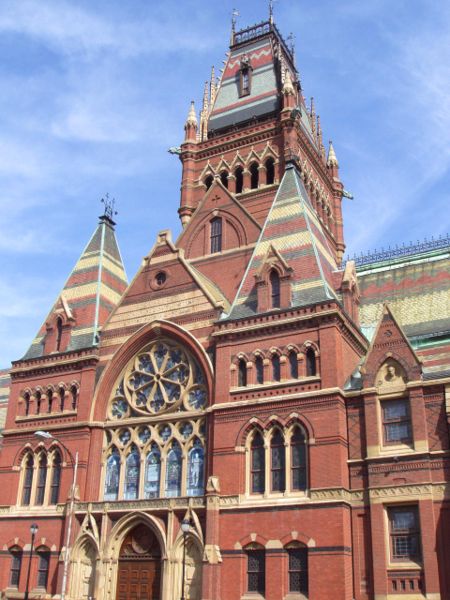
The image is of Memorial Hall, where Davis gave her address.