

 Today's question comes from Jeff Yates, a professor of political science at Binghamton University (and a recent visitor at Florida State's law school).
Roger Maris hit 61 home runs in 1961, setting a new season record. No
one came within five of that number until 1997, when Ken Griffey, Jr., jacked
56 taters for Seattle and Mark McGwire went "yard" 58 times for the
A's. During that 36-year span, the most home runs hit by any other
player in a season was only 52. Name the three players to do so.
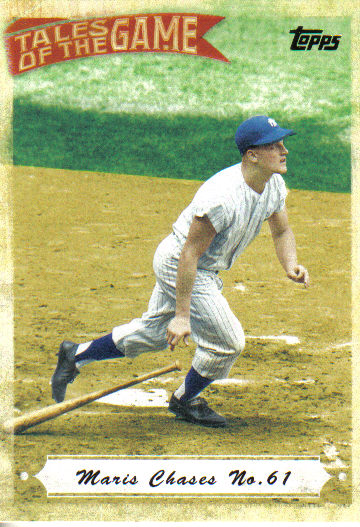
Pictured: Roger Maris card, from the 2010 Topps "Tales of the Game" set. Maris was a two-time league MVP. Does he belong in the Hall?
Willie Mays and George Foster have to be two. The third is either Mark McGwire or Cecil Fielder.
I'm pretty sure it was Cecil Fielder.
And don't forget that Mickey Mantle hit 54 in 1961 as well. (I suppose that's technically not within your time frame.)
Before the decade of the steroids (1990's) only ten men had hit 50 in a season. Can you name them?
(The question is perhaps unfair to Cecil Fielder, who hit 50 in 1990. Some observers would say that the steroid era began in the mid-1990s.)
Babe Ruth, Jimmy Foxx, Roger Maris, Mickey Mantle, Willie Mays, George Foster, Hank Greenberg, Hack Wilson
Maybe Ralph Kiner, but I'm not sure.
I will let Tim handle the question, but I had a related open ended question for the audience – someone a few years ago had put together a list of all time single season home run leaders that included a number of caveats such as pre-steriod era; no expansion teams that year; and some other considerations – can anyone find this? I cant seem to locate it on the web – it was interesting (although I debate a few of his points).
Mays, Foster, McGwire
Mays (1965), Foster (1977), and McGwire (1996) are the correct answers. Cecil Fielder hit 51 in 1990.
What I find amazing is that Henry Aaron never hit 50 homers in a season (high was 47). Another surprise is that Harmon Killebrew never hit 50, either (although he smacked 49 homers twice, and 48 dingers once).
As for the ten men to hit 50 or more homers in a season before 1990:
Jimmie Foxx (50 in 1938)
Johnny Mize (51 in 1947)
Ralph Kiner (51 in 1947)
Willie Mays (51 in 1955)
George Foster (52 in 1977)
Mickey Mantle (52 in 1956)
Willie Mays (52 in 1965)
Babe Ruth (54 in 1920)
Babe Ruth (54 in 1928)
Ralph Kiner (54 in 1949)
Mickey Mantle (54 in 1961)
Hack Wilson (56 in 1930)
Jimmie Foxx (58 1932)
Hank Greenberg (58 in 1938)
Babe Ruth (59 in 1921)
Babe Ruth (60 in 1927)
Roger Maris (61 in 1961)
Source:
http://www.baseball-reference.com/bullpen/50_Home_Runs_in_a_Season
Not to suggest that steroids, and the crazy numbers they helped produce from 1994-2006, were not a problem in baseball and baseball's records. But the premise underlying the question seems to be that only three players came close to Maris for 37 years, then the record was constantly under assault for the next five years, so it must have been a result of steroids. But look at this list–three people came within five of Ruth within the first decade (and Ruth himself came within six the very next year). The early 30s long have been recognized as a time of crazy offensive numbers (there was a book to this effect a few years ago).
Which is to say that steroids alone should not be blamed for the offense/pitching imbalance of the late-90s and early 00s. Such imbalances have come along for non-steroid reasons throughout baseball history.
Which is to say that steroids alone should not be blamed for the offense/pitching imbalance of the late-90s and early 00s. Such imbalances have come along for non-steroid reasons throughout baseball history.
Indeed, but the interesting question is what led to the imbalance? Sometimes we can look to rule changes, like the changes in the ball itself around 1921 and the lowering of the pitching mound after the 1968 season, that have significant alterations in offensive and defensive numbers. I'm not sure what led to the offensive craziness of the late 20s/early 30s, but it could have just been the tail end of a herding instinct or norm cascade–about ten years after Ruth started swinging for the fences, enough other players had followed in his mold to make a systematic impact on the game.
But just because there have been other fluctuations in offense and defense in baseball doesn't mean steroids weren't the reason in the late 90s. They well may have been, and I think this may delegitimize the records set then in a way different from records set due to factors that aren't cheating.