

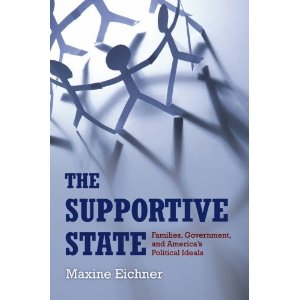
 Well, I mentioned a while back how excited I am about the fall press catalogs. The books are starting to roll off the presses and I thought I'd mention two new ones. First, my colleague Maxine Eichner's The Supportive State: Families, Government, and America's Political Ideals. From the OUP website:
In The Supportive State, Maxine Eichner argues that government must take an active role in supporting families. She contends that the respect for human dignity at the root of America's liberal democratic understanding of itself requires that the state not only support individual freedom and equality–the goods generally considered as grounds for state action in liberal accounts. It must also support families, because it is through families that the caretaking and human development needs which must be satisfied in any flourishing society are largely met. Families' capacity to satisfy these needs, she demonstrates, is critically affected by the framework of societal institutions in which they function. In the "supportive state" model she develops, the state bears the responsibility for structuring societal institutions to support families in performing their caretaking and human development functions. Although not all family forms will further the important functions that warrant state support, she argues that a broad range will.
What I find particularly interesting about Max's argument is that she's grounding the supportive state in liberal theory. For a lot of us there's a more direct — though perhaps somewhat less persuasive to many voters — argument about the community's duty (and I would add self-interest) in taking care of families and others in need. I had the pleasure of hearing Max give a talk about this last week and it struck me that there are a lot of parallels between what Max is talking about and the arguments around reparations, some of which are grounded in returning people to the position they would have been in, while other are grounded in social-welfare arguments (like the last chapter of Reparations Pro and Con).
Then we have Diane Mazur's A More Perfect Military: How the Constitution Can Make Our Military Stronger. Again from the OUP website:
A More Perfect Military explains how the Supreme Court used the cultural division of the Vietnam era to change the nature of our civil-military relations. The Supreme Court describes itself as a strong supporter of the military and its distinctive culture, but in the all-volunteer era, its decisions have consistently undermined the military's traditional relationship to law and the Constitution. Most people would never suspect there was anything wrong, but our civil-military relations are now as constitutionally fragile as they have ever been.
A More Perfect Military is a bracingly candid assessment of the military's constitutional health. It crosses ideological and political boundaries and is challenging-even unsettling-to both liberal and conservative views. It is written for those who believe the military may be slipping away from our common national experience. This book is the blueprint for a new national conversation about military service.
But would that be supporting families at the expense of singles? There's already a lot of debate at many workplaces about the inequality that happens when parents get to or have to take time off work for their children and the other people in the office must pick up the slack.