

 Over at The Accidental Slaveowner, Mark Auslander discusses last week's statement of regret by Emory University's board of trustees regarding their connections with slavery. Mark also links to a statement by Gary Hauk, Emory's Vice-President, about Emory's history.
This is just in time for discussion at Emory's conference next month on universities and slavery. But one of the things that interests me is that there has not yet been more discussion of the Emory's statement. I suppose this is partly because they are more common now than even a decade ago. You may recall that Emory joins a number of institutions — the Universities of Alabama and Virginia — and a number of states — including Virginia, Maryland, and Alabama — that have apologized or otherwise expressed regret for their connections to slavery. This may make it easier for other institutions to make similar statements.
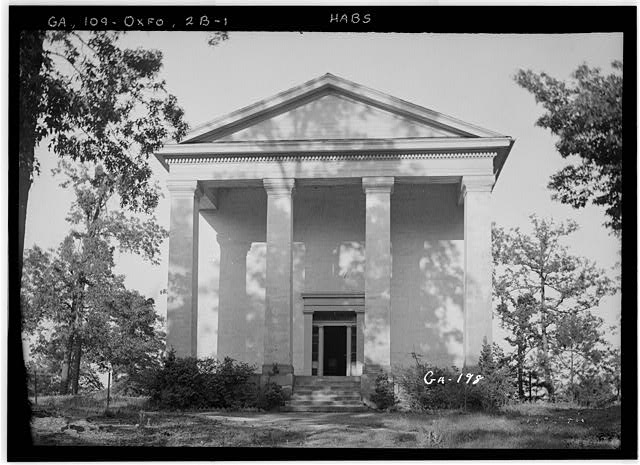
The image is of the Emory's Few Literary Society at Oxford, from the Library of Congress' Historic Buildings website.
Al, I imagine we'll see more discussion in coming weeks of the Emory board statement once classes and the campus newspaper start up again; it just happened, and everyone has been snowed in due to the weather. I wonder how precisely the university media relations office is playing this up, beyond the press release. I imagine that as they publicize the slavery and universities conference, they will try to fold in the Board resolution story.
By the way, what sort of word is "entwinement"? I wonder why after all the debate over the language of the resolution that particular term was settled upon? Is it a 19th century legal term, or a bit of a neologism>
A quick and very minor historical correction: the forerunner institution to Emory University was in fact termed "Emory College" from 1836 onwards. It was located in Oxford, Georgia. "Oxford College" is a mid 20th century creation.
Entwinement–21st century neo-logism, don't you think?
Ah, I just checked Skeat's 1898 Etymological Dictionary which notes that Milton uses "entwined" in Paradise Lost, but which does not list "entwinement." I'll need to check just how this term was incorporated into the compromise language of the final Emory resolution. I suppose "en-manacled" is not a word, but the imagery would be rather less benign than that of two balls of yarn tangled up with one another, which is perhaps the poetic connotation of 'entwinement'!
Book.google — my preferred mode of research these days — shows that Adam Smith used it in Wealth of Nations. So not a neo-logism, as you point out, Mark — but it seems to have been rarely used in the antebellum era.