

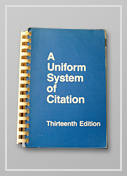
 Josh Blackman has a nice chart showing how the Bluebook has expanded continuously over the years from its first edition (28 pages) to its tenth edition (131 pages) to the newest version, which weighs in at a whopping 512 pages. Perhaps this is because there is more law. Or perhaps its because we've realized that there is no law, so we need more ways to help imagine what the law might be if in fact there were law. Or perhaps in the face of this new absence of law, editors have become terrified and are doing their best to create something resembling stable rules in their own small domain.
Shall we have a conference on this question? God knows people have been pondering these issues.
BTW, you can read the original 1926 edition here. Look at all the editions here.
H/T ATL
The newest edition supplies citation guidance for several more countries — a welcome addition for creating a common framework in a profession that is increasingly global in nature. I'll take the extra pages if they're helpful in that respect. So far, I think they are.
The "Bluepages"–which are supposedly intended for practitioners and law clerks (like law review editors are in a position to tell practicing lawyers anything)–are an abomination. For example, they inform lawyers that they should underline case citations rather than italicizing them. Why, given that all word processing programs allow writers to italicize with ease?
I haven't consulted a Bluebook since I was an editor of the Columbia Law Review, and I intend to stick to that habit until I die. I do, however, employ common sense, a source that I have found to be far more useful in life than reliance upon 531 pages of rigid formulae.
If it were agreed that couts should not rely on foreign law, maybe that would save some pages. (Just joking …)
Since we rely on the students to run the show in the legal academy (select "good" scholarship and "edit" our work), we are at their whim. Faculty-edited journals could adhere to any rules that they like. I'm all for the switch and would be willing to do the work of peer-review that is required (and typical in the academy). Are you?
+1 junior prof.
Junior Prof,
I have reviewed your submission, and it doesn't cite me. For that reason, it is unsophisticated, and I decline to publish it in my law review. Sorry it took me more than a year to tell you that; I was busy with other things.
Good luck with your career, as you'll need it.
-Senior Prof
Funny point, senior scholar – yet a fair depiction of the peer review process. It has its advantages, but also disadvantages. As for the blue book – only disadvantages – it is, in a word, ridiculous. That so much time and energy are spent on it is unfortunate. Say what you mean, mean what you say, and tell me how I can find your sources … pretty simple, really.
Senior Prof,
Well said – point taken. It's always nice to hear "how it is" from our senior colleagues. I'd like to think that good scholarship will get noticed, regardless of rank of publisher. Any thoughts on this query?
cheers,
JP