

 Well, I'm back from an extended research trip, working mostly on the jurisprudence of slavery and freedom at Washington College — which took me to Richmond for time at the fabulous Library of Virginia. That's the place where I first read Stowe's Dred: A Tale of the Great Dismal Swamp and Cobb's An Inquiry into the Law of Negro Slavery lo' those many years ago, so it occupies a very, very important place in my heart. And to the library at West Chester University, to get a copy of a cemetery dedication address from 1854, and to the Washington and Lee University special collections for some astonishingly rich archives. As I said to one of the librarians, I guess that's the kind of detail that's available when your campus isn't burned during the war!
As the paper comes together I'm going to be talking about a bunch of different things in it — the switch from Enlightenment to romanticism to empiricism; the switch from anti-slavery to proslavery; the nature of utilitarian reasoning in proslavery thought; the differences between Washington College and VMI. And maybe even something about the nature of the college's relationship to enslaved people it owned, though my primary interest is the ideas of the slave-holding class. I know, I know — I'm interested in the dead, white, slaveholders.
I also want to talk about the Thomas J. "Stonewall" Jackson cemetery in Lexington at some point soon. It's got a lot of really cool things going on there; it changes style from a typical early 19th century cemetery to a rural cemetery part way through — which is cool enough to warrant discussion. But the people who're there are simply extraordinary. More on that shortly.
 But right now I want to talk about something a little different — campus architecture. The different styles of campus buildings is on my mind right now because I've been on so many different campuses in the past couple of weeks and, thus, have a sense of how distinctive the architure is (and how often it's unified). Two weeks ago I was at Swarthmore and then last week at VMI; I suppose it's hard to imagine two campuses with more different student bodies.
One thing I wanted to talk about regarding Swarthmore, which I have visited only a couple of times since I was in college, is their bell tower. As I was walking up their great lawn, I saw that tower and thought, how un-Quaker like. That certainly can't be their meeting house! I suppose that was a concession to the dominant style of middle Atlantic college architecture in the early twentieth century.
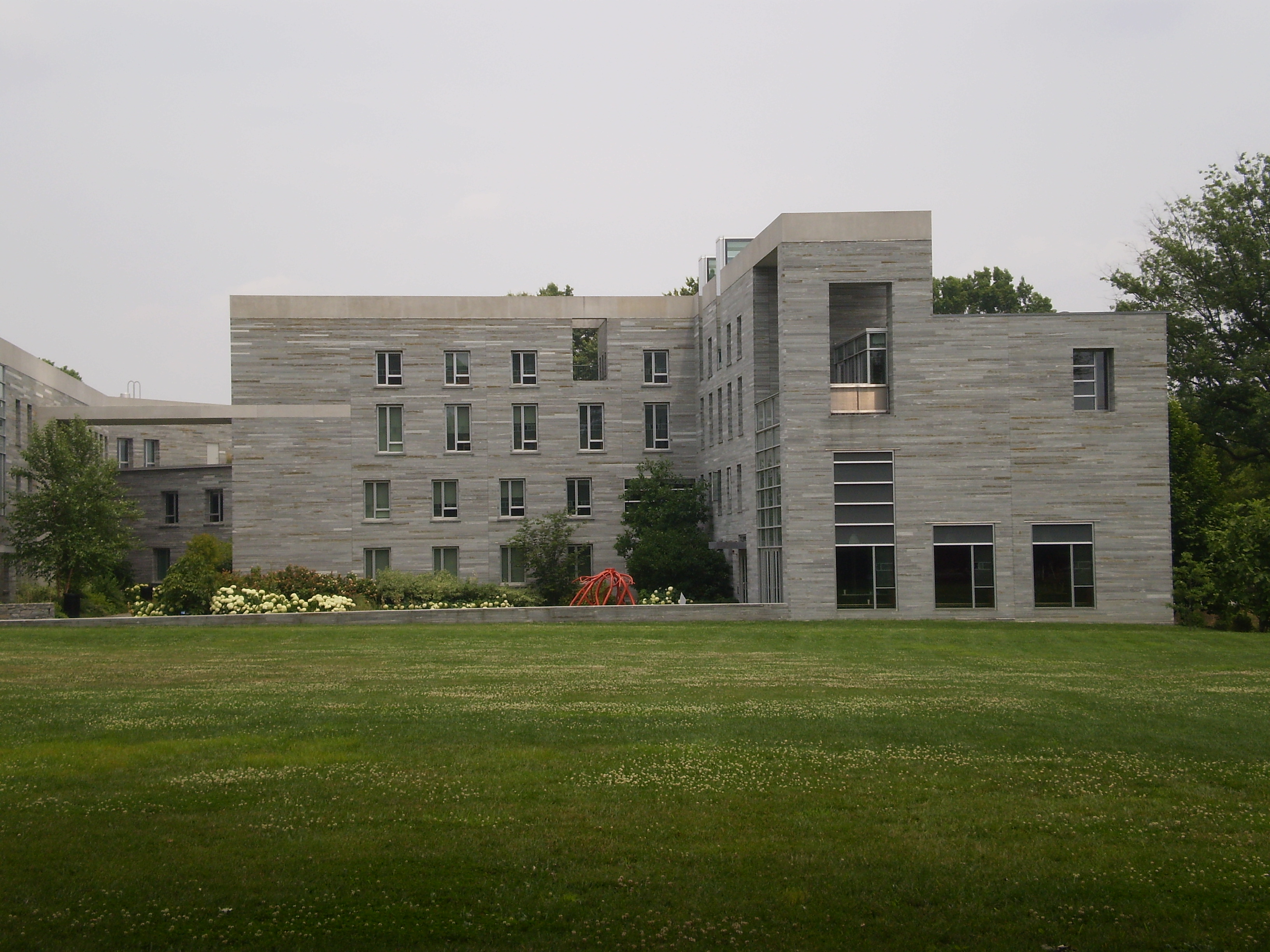
Still, even their new buildings are built to fit in with the rest of the nineteenth-century campus. Take Alice Paul Hall, for instance (the illustration in the upper right of this post). I started off taking that picture so I can use it when I teach In re Strittmater in trusts and estates this fall. Then I realized that I wanted it to illustrate how even over decades campus architecture can still remain fairly integrated.
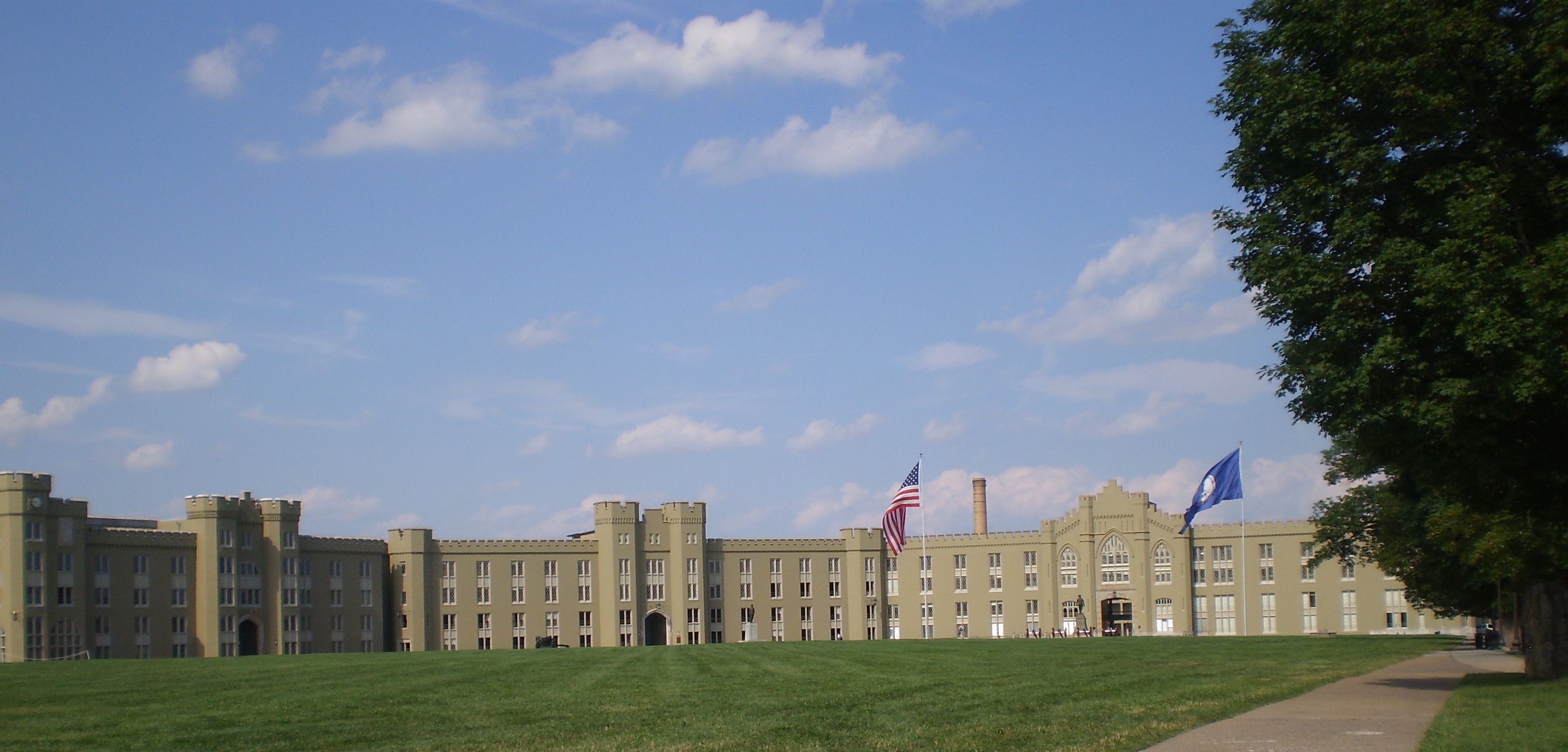 And then there's VMI. Again a very consistent campus architecture. (Here's a pretty amusing vignette, by the way. As I was wandering around the VMI campus last week I had the distinct impression that one of their — I'm guessing by her age and appearance — professors looked at me taking a picture of the "Virginia Mourning Her Dead" monument with that look of "here's another neo-Confederate nut coming to worship at the monument to the Confederacy." Not that different from the look I got when I was in Linn Park in Birmingham back in February.)
Washington and Lee, of course, also has incredibly unified architecture — except, I guess, for the law school. There's probably a pretty interesting story in all that.
So that leads me to two questions, on which faculty lounge readers will have a great deal of expertise. First, what schools have the most unified architecture? And which schools have the least? I'm guessing that southern schools will, by and large, have the most unified architecture — Duke, William and Mary, and to a lesser extent the University of Alabama (though conspicuously not UNC and UGA) have quite unified architectural styles on their campuses.
But for two regretful buildings that houses our cafeteria & science departments and were probably built in 197X, Hollins University has lovely (Southern) integrated architecture, including our relatively new library. http://www.hollins.edu/library/index.shtml
I've been thinking about my alma mater a lot as I've read your posts from the surrounding (formerly men's) schools.
W&L's law school building (the early 1970's brutalist/modernist Sydney Lewis Hall) was inspired by UNC-CH's then state of the art law school building, Van Hecke-Wettach (sp?) Hall. The W&L dean at the time — Roy Steinheimer I believe — loved the new modern building in Chapel Hill and somehow convinced the powers that be at W&L (backed, no doubt, by modern art lover and collector — and major donor — Sydney Lewis) to echew the beautiful federal style architecture of W&L's main campus. Just as UNC folks can agree that Van Hecke-Wettach is now a monstrosity, so too W&L folks view Lewis Hall as similarly horrendous (both from the outside, at least, and when compared to the rest of their respective campuses).
Mink-Heel — that's an awesome story. No wonder I felt at home there! Alabama's law school building from the mid-1970s is quite similar, too — clearly there was a style to the southern law school building circa 1970-1980.
Am I right in thinking that the law school building and the main library at W&L are really the only two buildings that depart from the general 19th century style of the campus? I get that the Lee Chapel has a somewhat different feel from the colonnade — but still very nineteenth century.
Kate–I've not yet been to Hollins, though I'd like to take that campus in soon.
Perhaps it's just a campus legend, but most of Vanderbilt's buildings in the central campus are of a very particular red-brick, Victorian/Gothic style, except for one, with a white-stoned, castellated thing going on. The story is that Vandy and Duke were using the same architects on projects at the same time, and that the Duke stones were delivered to the Vandy campus. Rather than endure the expense of the mistake, they just built the Duke building in Nashville. I have no way of knowing if this is just fodder for campus tours, but that building does stand out quite.
Go 'Dores.
It's Furman Hall, and I haven't found anything to substantiate my story after 10 whole minutes on the internet.
JRB — That would have cost a truck-load of money to get the stones from Durham to Nashville (or vice versa)!
All of this reminds me, though, of another question I might pose to faculty: how many campuses have cemeteries (or at least people buried on them)? Isn't one of Vanderbilt's chancellors is buried near the center of your campus (Garland, no?). I'm interested in Chancellor Garland for other reasons — his time at Alabama and Randolph Macon before that and his time as a student at Hampden Sidney. But that's a story for another time. During my visit to W&L I heard that only two, I think, people are buried on campus — a major donor, John Robinson, and the General, of course. And VMI has several cadets killed at New Market.
Georgetown has a sizable cemetery smack in the middle of campus. I was told that monks are buried there.
Rhodes College in Memphis has extremely unified architecture – collegiate gothic stone buildings, slate roofs. I believe the stone all comes from the same place (I forget where), and the builders use an algorithm to create random placement of shapes/colors of stone. Sewanee (Univ. of the South) is similar, although it might have a little more variety.
For a different part of the world, I think the University of Colorado is remarkably consistent for a school of its size.
Williams College (like the other New England colleges I know) does NOT have especially unified architecture, but it has a cemetery on campus.
Yes, Vandy has tombs in the central campus, the Bishops' Commons:
http://www.vanderbilt.edu/virtualtour/vtour_ss.html
(Al, I love your posts, by the way. You're interested in things that interest me, and I'm glad you take the time to write about it.)
(See slide 09 for the tombs…)
Shouldbe–good to know about Rhodes and Sewanee. Haven't been to either, yet, though I'd love to take both of them in on my next trip to Tennessee. Colorado has a wonderfully unified campus, doesn't it. And good to know about Williams' cemetery and Georgetown's, too — this sounds like there's a lot to be done with college cemeteries…. Northeastern schools seem to be not so good on unified architecture — though they often have really beautiful settings.
JRB–thanks for the kind words — love that picture of the graves on Vanderbilt's campus. I'm vaguely remembering that Chancellor Garland's grave is right near there.
Duke actually has different campuses with unique architectural styles. The original campus, now "East campus," represents the red Georgian southern style mentioned in earlier posts. The central & "West" campuses are the widely recognized neo-gothic (ala Yale, parts of Swarthmore) architecture. The interesting fact is that the "newer" (i.e. Western) campus tries to look older than the "old" eastern part. This is cited by many who want to put Duke down as an institute of new money. Looking at the law school & business schools, their complexes are relatively new and they both try to match the beige stone of the gothic campus. This organization "works" in a sense, because the east campus is itself contiguous and distinct from the more sprawling gothic wonderland.