

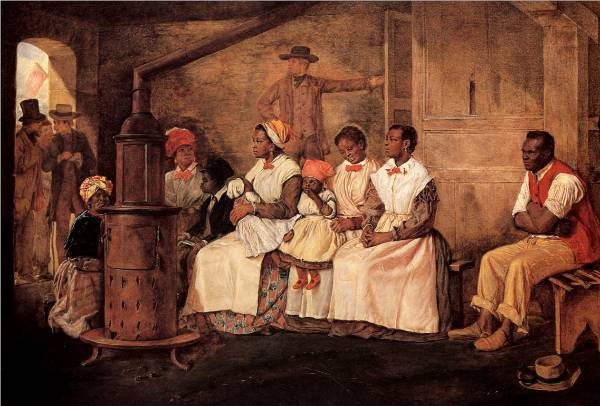
 I want to call your attention to Maurie McInnis' Slaves Waiting for Sale: Abolitionist Art and the Slave Trade. It's a beautifully produced book and a fabulously interesting one, which focuses around anti-slavery depictions of slaves in art and in particular a British artist, Eyre Crowe, who came to Richmond in 1853. It is a big book in conceptualization — it places art at the center of analysis and suggests some of the ways that it exercised influence on the anti-slavery movement. And it uses the art to tell the story of slavery, too. At the end, McInnis returns to Richmond today to map where the slave sales took place. Many were down town — just a few steps from the state capitol building. Though the buildings aren't there now, I think I need to take some pictures next time I'm up there way to get a sense of the
After I've finished digesting this I hope to talk more about how the art illuminates the connections between law and slavery — and perhaps also how the art illuminates the law of slave sale, which Ariela Gross first opened up in Double Character.
The image of Crowe's Slaves Waiting Sale is from our friends at wikipedia.
That picture was my desktop image for a long period of time.
It's a great book; you'll love it.