

 Close readers of the faculty lounge may recall that I love the opening of Anthony F.C. Wallace's Rockdale. The book, published in 1972, is a great example of blending social history, based often on quantitative sources, with ideology. It begins in this way:
There is a village in American called Rockdale where the people used to manufacture cotton cloth. It lies along the banks of Chester Creek in Delaware County, in southeastern Pennsylvania, between Philadelphia and Wilmington. None of the people who worked in the first cotton mills is alive anymore, but some of their children's children still live there, and the ruins of stone factories, as well as stone tenements and fine stone mansions, are yet standing. Nearby are remains of the other hamlets that made up the Rockdale manufacturing district–Lenni, Parkmount, West Branch, Crozerville, Glen Riddle, and Knowlton–where cotton yarn was spun on mules and throstles and cloth was woven on looms powered by water wheels. …
As I leave my house on the outskirts of the village, drive the car along the roads, stroll along the paths in the cemetery at Calvary Church, I sometimes feel that I can almost reach out and touch the people I have come to know from their letters and diaries and ledgers, that they are near, behind a thin veil of time. It was just yesterday, just down the road. And it was so far away, so long ago. … In a certain mood of elegiacal sentimentality I can see old Rockdale glimmering through a golden haze, where the spinster Sunday School teacher Clementina Smith and her sister Harriet are still sweetly instructing the mill hands in the elements of Christian faith, and the nervous manufacturer John P. Crozer still sweats over preparing a report to the Board of Directors of the Delaware County National Bank, and John S. Phillips, that clever mechanic, still drives his horse Mazeppa in a Byronic fury down the hills and over the bridges to court the Du Pont girls on the Brandywine, fifteen miles away.
Stephen Davis and I modeled the opening of our article on probate in antebellum Alabama on Rockdale. As I wrote last February:
Every time I read those words again, I recall that it's one of my regrets in life that I didn't take a class with him when I was in college. Too soon old; too late wise. But I do plan on making a trip by Rockdale next time I'm visiting Filler in Wallingford, because it's just down the road.
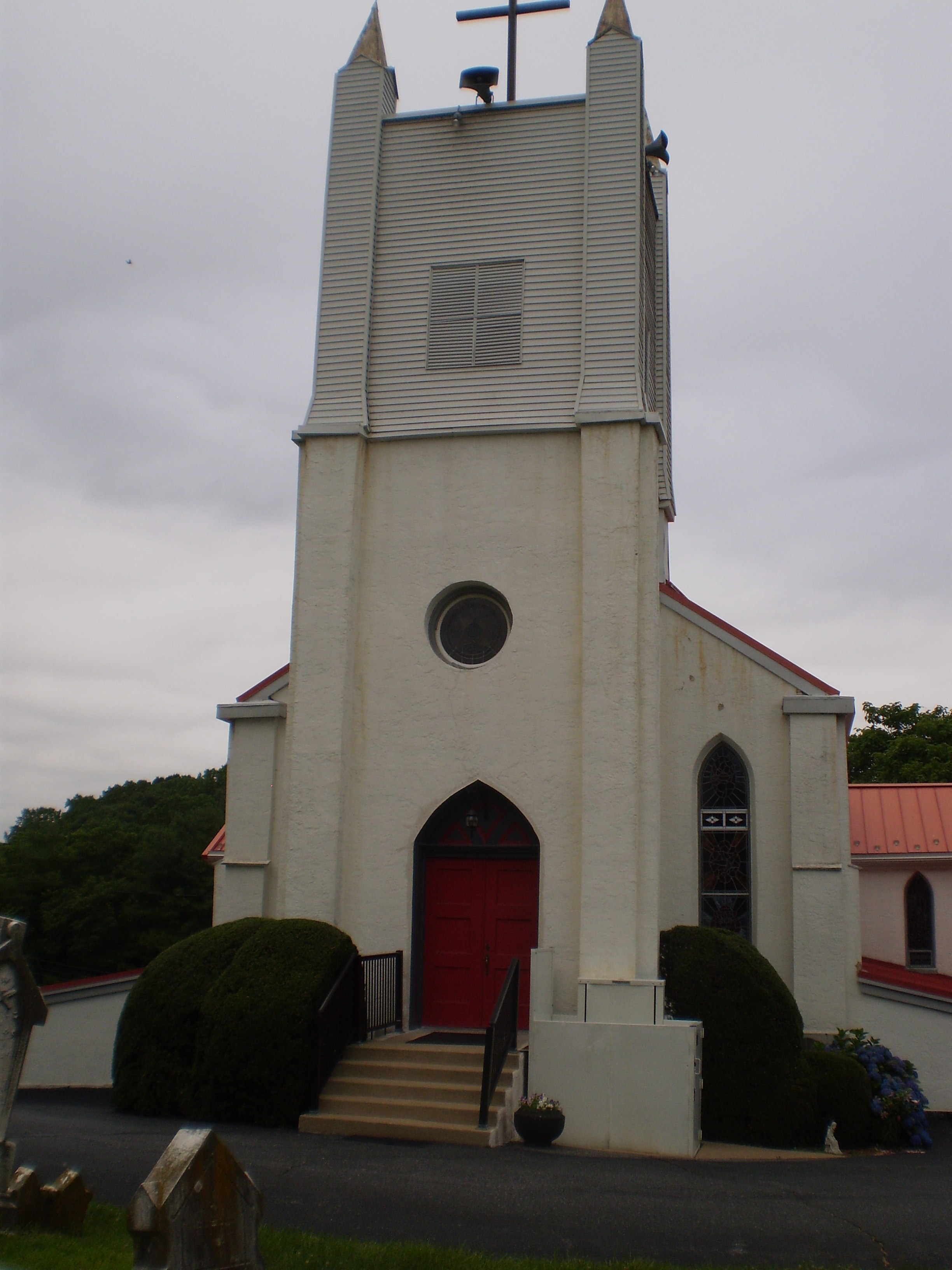
Well… I was briefly in the land of hoagies and Wawa (or should I say Wawas?) recently and had occasion to stop by Rockdale. (Perhaps this post is part of my continuing series on law professor loose in public.) It's not quite what I had in my mind's eye — I was thinking it would be a little more like Ridley Creek State Park. But it's what I should have had in mind, because its name says it all: rocks and hills. It's shockingly easy to get to — just off 452 south of route 1. (Driving south on 452, make a right on Mount Road, in Aston.) This quiet industrial village rises above the west branch of Chester Creek. The Calvary Episcopal Church, which loomed so large in Wallace's Rockdale, is still there. That's the picture I use for illustration — and a lot of the houses that go back to the nineteenth century are there as well, along with some that look more early twenty-century-ish. This is well worth a visit to see how much the village retains the signs of nineteenth century industrialism — and some of its eighteenth century origins as well. (According to a story in the Rockdale weekly newspaper, Cornwallis' troops camped here in the wake of the Battle of the Brandywine.)
What I love about Rockdale is that it combines social history with intellectual history — it shows how the lives and work of the residents combined with the ideas of the market and Christianity, all topics of singificant interest to me these days. (There are, I suppose, distant echoes of this linking in the missionaries in Hawaii who were operating at the same time, though I hadn't made those connections before.)
Next time I'm back in the land of hoagies I want to stop by the Newlin Mill Park, which is also on the west branch of the Chester Creek. The Newlin Mill goes back to the early seventeenth century, so it's a substantially earlier site for historical study than Rockdale. It's been beautifully preserved. I also have an interest in it because Francis Daniel Pastorius included a partenership agreement for a grist mill in the Young Country Clerk's Collection treatise. So that mill can be a place where I can talk about forms of physical and intellectual technology at the same time. More on this in July, I hope.