

 They're talking about adding the slave quarters to the tour at the University of Alabama again. The physical surroundings at the campus — like the slave quarters — really convey well the connections of the University to slavery.
For those who can't make it to Tuscaloosa for the tour, here's an article that discusses the ideas of education, slavery, and politics in circulation on that campus before the war. I focus on the addresses — often given at the beginning of the school year, though also on July Fourth — that distinguished visitors gave to the students and faculty. Women and enslaved people were sometimes in the audience at those addresses as well. Those addresses illustrate the intellectual connections between the University and the defense of slavery.
If you're interested in the ideas in circulation at southern universities before the war, here's an article on addresses at UNC and another one on the ideas of William and Mary history professor Thomas Dew, who wrote a proslavery pamphlet in the wake of Nat Turner's rebellion.
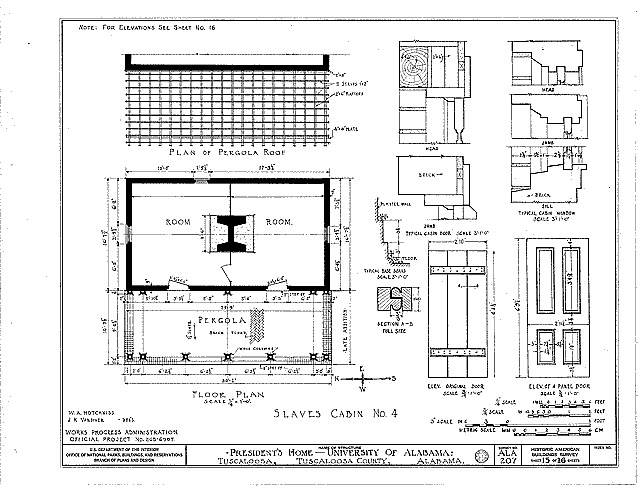
The illustration is from the Library of Congress' fabulous Historic Buildings Survey. It's one of the slave quarters behind the President's Mansion.
I don't think many other scholars appreciate just how important public history is- good public history would be a fundamental component of any genuinely democratic constitutionalism (so much so that we would need a kind of "public historiography.")
On a related front, see the recent news from Monticello:
http://www.monticello.org/site/press/monticello-to-receive-10-million-gift-restoration-efforts
I'm in 100% agreement with you on this, Matt. Public history is crucial in shaping how people think about our past, and ultimately, our present. Groups like the United Daughters of the Confederacy recognized in the early 20th century. That understanding has been lost over time and I think it's unfortunate that academic history is too frequently divorced from public history.