

 Here is the program for Tulane's Conference of Global Perspectives: Regimes of Redress and Reparations, Transitional Justice, and the Rule of Law. The conference is next Friday and Saturday, March 16-17.
Friday March 16
8:00-8:45 a.m. REGISTRATION & BREAKFAST
8:45-9:00 a.m. WELCOME: Robert S. Westley
Dean David Meyer
9:00-11:00 a.m. PLENARY Reparatory Justice for Colonialism and Imperialism
Presenters and Topics
Tayyab Mahmud, Global Responses to Colonial Exploitation
Anna Schirrer, The Caricom Reparatory Justice Program
Howard Taylor, The Ova Herero Claims Against Germany
Caleb Lauer, Indigenous Land Claims in Canada
Badrinath Rao, State-sponsored Carnage, Justice and the Law in India
11:00 -11:15 a.m. Break
11:15 – 12:15 P.M. KEYNOTE ADDRESS
Ana Lucia Araujo, Reparations for Slavery and Slave Trade: A Transnational and Comparative History
12:30 – 1:30 p.m. LUNCH
1:30-3:30 p.m. PLENARY Complicity, Accountability, and Transitional Justice
Presenters and Topics
William Darity/Kirsten Mullen, Accountability for Slavery
Anne Farrow, Complicity: How the North Profited From Slavery
Williamson Chang, New Visions of Justice
Shalini Ray, Transitional Justice as Ordinary Injustice
Darrin Johnson, Constitutional Reform As Reconciliation
3:30 – 3:45 p.m. BREAK
3:45 p.m. – 5:00 p.m. PLENARY Comparative Reparations Policy: The German Model
Thomas Craemer, Comparative History of Holocaust and Transatlantic Slavery
Christian Jasch, Postwar Reparations Policy in the Two Germanys
Sarah Kiani, State Responses to Social Movement Claims to Rehabilitate Homosexual Victims of National Socialism
7:00 – 9:00 p.m. DINNER
Saturday March 17
8:00 – 9:00 a.m. BREAKFAST
9:00 – 10:30 a.m. PLENARY National Responses to State-Sponsored Atrocity and Dispossession: Perspectives from the European Context
Presenters and Topics
William Pettigrew, National Self-Interrogation as Reparative History (UK)
Myriam Cottias, State of the Question of Reparations (France)
Nancy Jouwe, Mapping Slavery Project (The Netherlands)
10:30-10:45 a.m. BREAK
10:45-11:45 a.m. PLENARY KEYNOTE ADDRESS
Hilary McD. Beckles, Britain’s Black Debt: Reparations for Caribbean Slavery and Native Genocide
12:00 p.m.-1:00 p.m. LUNCH
1:00 – 2:30 p.m. National Responses to State-Sponsored Atrocity and Dispossession: Indigeneity and Multiculturalism
Harry Hobbs/Megan Davis, Aboriginal and Torres Strait Islander Rights (Australia)
Kunihiko Yoshida, Ainu Reparations
Natsu Saito, Can Foundational Wrongs Be Redressed?
2:30-2:45p.m. BREAK
2:45-4:30p.m. U.S. Based Perspectives on Slavery Reparations
Harold McDougall, Brown at Sixty: The Case for Black Reparations
Adjoa Aiyetoro, Revealing the Depth of White Supremacy in Seeking Reparations Now
John Torpey, Towards A More Perfect Union: An Approach to Rectifying Racial Inequality in American Life
Tuneen Chisolm, When Righteousness Fails: The New Moral Economy Incentive for Reparation for African Americans
CLOSING REMARKS
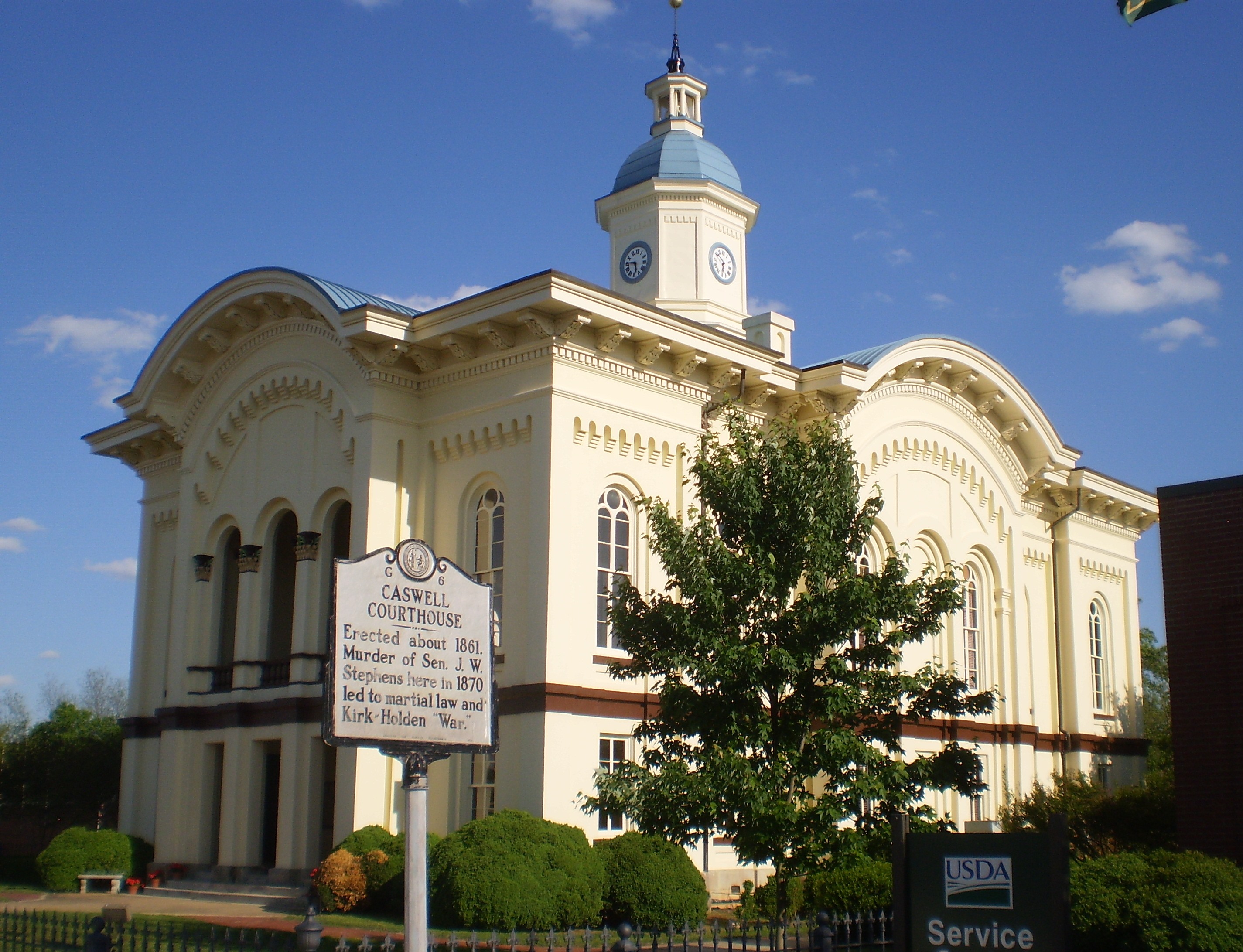
The illustration is the Caswell County, North Carolina, courthouse, which was the scene of a murder that set off the Kirk-Holden "War" during Reconstruction. I guess you'd have to say that Governor Holden who declared martial law to try to wrest control from the Klan (and other white supremacy groups) lost the "war" and that was part of the end of Reconstruction in North Carolina. That vignette appears in the paper Shalini Ray and I are writing that uses Reconstruction as an (often-overlooked) example of transitional justice. We argue that Reconstruction illustrates why transitional justice needs to move outside of the traditional forms of "justice." Hence, our title that riffs on Eric Posner and Adrian Vermeuele's much-discussed article from the Harvard Law Review, "Transitional Justice as Ordinary Justice."