

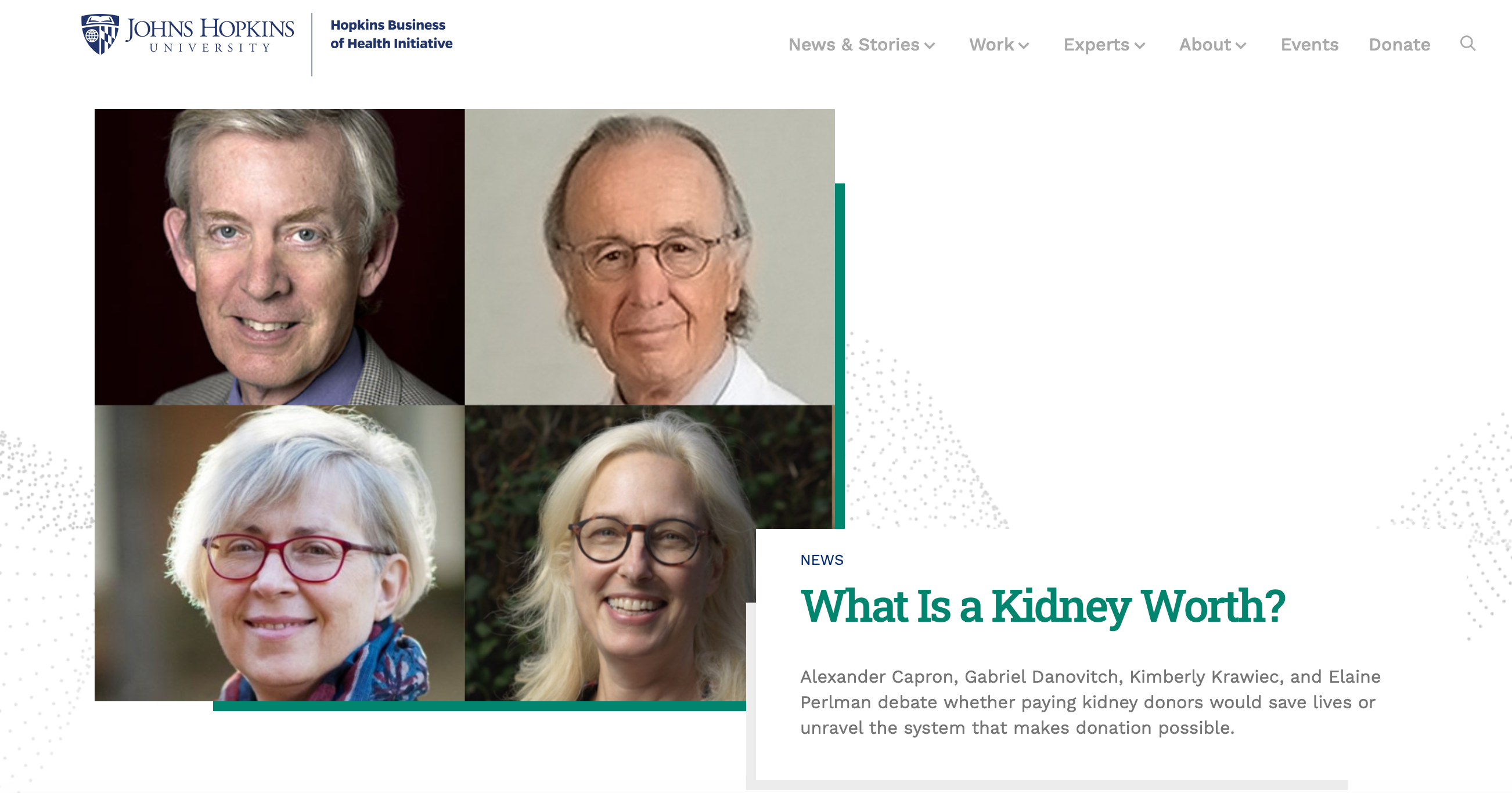
 The Hopkins Business of Health Initiative (HBHI) has published a summary and synthesis (link here) of the debate I previously discussed (here and here), with the full recording embedded and links to resources shared by each of the speakers.
From the article:
Alexander Capron, Gabriel Danovitch, Kimberly Krawiec, and Elaine Perlman debate whether paying kidney donors would save lives or unravel the system that makes donation possible.
More than 100,000 Americans are waiting for an organ transplant. About 90,000 of them need a kidney. Thousands die each year before one becomes available, and the number of living kidney donors has stagnated for two decades, holding near 6,000–6,500 donors a year.
That gap is the starting point for one of the most contested questions in health policy: would paying people to donate close it, or would payment corrode the thing that makes donation work? For its May Conversations on the Business of Health webinar, the Hopkins Business of Health Initiative convened four people who have spent their careers on different sides of that question and asked them to argue it out over a single, concrete proposal: the End Kidney Deaths Act, a bipartisan bill that would create a 10-year pilot offering a refundable federal tax credit of $50,000, paid over five years, to people who donate a kidney to a stranger.
The panelists were Alexander Capron, LLB, Scott H. Bice Chair Emeritus in Healthcare Law, Policy and Ethics, USC Gould School of Law; Gabriel M. Danovitch, MD, FRCP (Hon), Internal Medicine and General Medicine, Nephrology, Olive View-UCLA Medical Center; Kimberly Krawiec, JD, Charles O. Gregory Professor of Law, and Glynn Family Bicentennial Professor of Law, University of Virginia; and Elaine Perlman, MA, President, Coalition to Modify NOTA and Executive Director, Waitlist Zero.
Read the whole thing here.