

What not to say on your blog (especially if you’re a public
defender): that your client lied to the court, and that certain judges are
clueless or a-holes, among other things.
ABA
Journal.
James Boyle, A
Copyright Black Hole Swallows Our Culture. (FT)
From The
Guardian, a review of the book Death
Can Be Cured, based on 100 entries from the journal, Medical
Hypotheses, including “Losing weight by defecating at night” and “Why do
gentlemen prefer blondes?” According
to the Guardian:
Medical Hypotheses publishes clever guesses about medical
mysteries. Most of the world's several thousand other medical journals do, too.
But Medical Hypotheses is unusual in that (1) it admits doing it and (2) it
publishes nothing else. No "now we know the real story" medical case
reports. No "thus it is proved" experimental results. Just
hypotheses.
New(ish) to the blawgosphere: Becky and Hollee – Inside the Journey To
a Balanced Life. Becky and Hollee write the work/life balance column for
the ABA Journal, and they’re co-authoring Good
Enough is the New Perfect: Why Modern Moms Are Aiming Lower — Yet Reaching New
Heights, a nonfiction book about how the working moms of their generation
are redefining success and taking control.
From Izabella
Kaminska (FT Alphaville):
Did the BBC mean for their dramatisation of the last days of Lehman Brothers to be
utterly, cringeworthingly hilarious?
If they didn’t, they certainly did a good job making it look
like they did.
 Dan Ernst at Legal History Blog on Securities
Regulation in the New Deal.
Felix
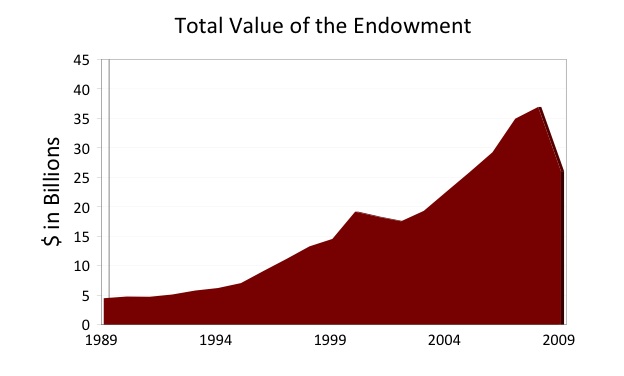
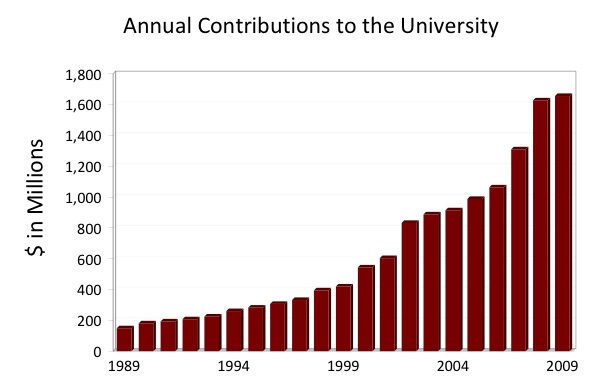
Salmon: “At the height of the worst recession in living memory, it seems,
donations to Harvard went up.” See
charts on total endowment (right) and total contributions (below), from the
Harvard Management Company report (click to enlarge). A copy of the report is here. See prior Lounge coverage of the
Harvard endowment here.
Correction: The chart actually shows an increase in contributions from the endowment to the University. As the Crimson notes, fundraising fell by 8%.
The perils of (really) frequent flying. (Wired Science).
From Paul Caron, Federal
Court Orders Thomas M. Cooley Law School to Give Tenure Hearing to Fired Law Prof.
Classic animation, via Crooked
Timber, including this Bank of America ad:
According to CT, John Hubley (of “Mr. Magoo” and other animation fame) did the ad shortly after he was blacklisted for refusing to testify to the House Committee on Un-American Activities, forcing him to leave UPA and take work making commercials. More from John Holbo at CT.
I'm delighted you linked to Solum on Sen: Amartya Sen, not unlike Jon Elster, is a philosopher masquerading as a social scientist, specifically an economist (and the body of work in both instances is truly remarkable). And Sen exemplifies all the virtues of the philosopher as a Stoic-like global citizen. As Sen writes in the Preface to The Idea of Justice (2009):
"[O]ne of the unusual–some will say eccentric–features of this book compared with other writings on the theory of justice is the extensive use I have made of ideas from non-Western societies, particularly from Indian intellectual history, but also from elsewhere. There are powerful traditions of reasoned argument, rather than reliance on faith and unreasoned convictions, in India's intellectual past, as there are in the thoughts flourishing in a number of non-Western societies. In confining attention almost exclusively to Western literature, the contemporary–and largely Western–pursuit of political philosophy in general and of the demand of justice in particular has been, I would argue, limited and to some extent parochial." [This has been true of professional philosophy on the whole, but that's a topic for another day.]
Indeed, and in this regard I hope Sen's book portends more works with such a capacious if not necessary reach.
Thanks for sharing this Patrick. I haven't yet read "The Idea of Justice," but am looking forward to it — especially after recommendations like these. Why does my reading list seem to only get longer, no matter how much I read? Impossible to keep up — don't know how the rest of you do it.
Kim,
Although I'm a voracious reader I always have oodles of books in my "to be read" pile: it's just the nature of the beast (thus it's impossible for damn near everyone to keep up). In my case, those close to me would only be too eager to tell you about how I miss numerous social events, family gatherings, and sundry experiences those of my class and background take for granted (I do attend weddings and funerals of those near and dear). So, (!) in many respects my life is well-described as "monastic." One reason I'm perfectly content to live this way is that I spent so much time outside of the academy (working in labor-intensive occupations) before re-entering it at middle age (and then, again, only part-time).
Of course the paradox or problem here is well captured by Elster's observation (although I've been informed it's not, strictly speaking, scientifically true) that, "as the surrounding circle of light expands, so too does the surrounding circle of darkness," in other words, the more we come to (or think we) know, the quicker we come to an intimate realization of the depth and breadth of our ignorance!
Numerical justification for our inability to finish our reading list, Patrick — http://normblog.typepad.com/normblog/2009/09/unread-books.html
Of course, not all books are worth reading, or added to the "to read" list. But it made me feel better, nonetheless.
And yet others see it like this: http://www.amazon.com/Solitary-Vice-Against-Reading-Counterpoint/dp/1593761872/ref=sr_1_1?ie=UTF8&s=books&qid=1253036486&sr=1-1
😉
Kim,
I should have mentioned that Brottman is referring largely to fiction, which I rarely, alas, find the time to read. (I learned of her book because she happens to be chair of a Humanities program to which I sent my CV.)
What's strange is that the reviews — about a book about why we should read fewer books — make me want to read the book . . .