

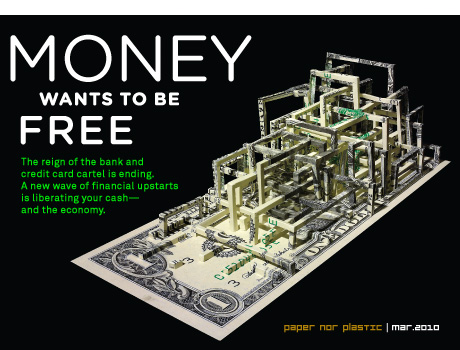
 Heard of PayPal? Sure.
What about Twitpay? Zong? Square? GetGiving? Hub Culture? No?
Readers may find fascinating the cover story in the March 2010 issue of Wired magazine (cover pictured in part), entitled The Future of Money: It's Flexible, Frictionless and (Almost) Free. A teaser from the article:
PayPal is just the latest company to try to harness the creative powers
of the open Internet. Google created a platform that lets anyone buy or
display online advertisements. Facebook allows any developer to write
applications for its social network, and Apple does the same with its
iTunes App Store. Amazon’s Web Services provides developers the
cloud-based processing power and storage space they need to build
applications and services. Now PayPal has brought this same spirit of
innovation and experimentation to the world of payments. Your wallet may
never be the same.
Here's a link to the story. And here's an accompanying link to diagrams that illustrate three different ways to move money.
Hat tip: Billy Saqr, one of over 75 students in my Payment Systems class this semester.
Different observers can disagree on whether two events at different locations occurred simultaneously depending if the observers are in relative motion (see relativity of simultaneity). This theory depends upon the idea of time as an extended thing and has been confirmed by experiment and has given rise to a philosophical viewpoint known as four dimensionalism. However, although the contents of an observation are time-extended, the conceptual observer, being a geometric point at the origin of the light cone, is not extended in time or space.
Thanks for the read. http://www.filepasswords.com