

 On this day in history — 1836 — Sam Houston led his Texan revolutionaries to a resounding victory over Mexico's General Santa Anna in the Battle of San Jacinto (not too far from downtown Houston). Santa Anna's army outnumbered Houston's forces, 1200 to 900. But in less time than last night's episode of Glee (I'll assume we have some Gleeks in the house!), the Texans had control of the opposing camps. Santa Anna lost more than 600 men, Sam Houston less than a dozen.
And what did this battle mean for Mexico and the United States?
For Mexico, the defeat was the beginning of a
downhill martial and political spiral that would result into the loss
of nearly a million square miles in territory. For the Texans, their
victory led to annexation into the United States and the United States'
war with Mexico. In the end, the United States would gain not only Texas
but also New Mexico, Nevada, Arizona, California, Utah and parts of
Oklahoma, Kansas, Colorado and Wyoming.
As a result of the Battle of San Jacinto, almost a third of what is
now the United States of America changed ownership.
Read more here (which also is the source link for the quoted passage and other details above).
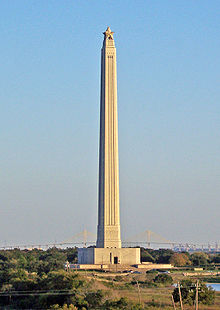
Pictured: the San Jacinto Monument, constructed in the 1930s to commemorate the Battle (and standing taller than the Washington Monument). Additional reading here.
Don't forget that the battle also meant that slavery could extend into the new territory. That was, after all, one of the big reasons for the fight in the first place.
Although, interestingly enough, despite his support for slaveowners during the First U.S.-Mexican War (or the Texas War of Independence), Sam Houston, who was still serving as Governor in 1861, vetoed the Lege's resolution of secession, refused to recognize their overriding of his veto, and (supposedly) barricaded himself in the Governor's mansion when secessionists attempted to oust him from office. While he was unsuccessful in preventing the secession of Texas, if true, that's a pretty badass story, and only proves the size of his…guts.
And it was a bold statement on his part, too, to be that strong of a Unionist at that point in time in Texas.