
For those of us likely to be embarking on new mentoring relationships either with new junior faculty or students this year, it may be worth taking a quick look at the revised edition of The Elements of 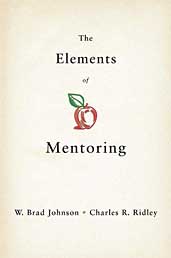 Mentoring
(by Johnson & Ridley). It's a nice summary handbook of the main issues to bear in mind when taking on a mentoring relationship in both professional and academic settings. It can be easily read in a day and goes through all the stages of a mentoring relationship including the personal qualities mentors should be able to identify in themselves and in their proteges.
Mentoring
Posted by
 5
5
As I recall, SEINFELD had one or more hilarious episodes built around mentors and proteges (Kenny Bana?).
Interesting. I'm curious, to the extent you can say, what's the basic advice?
Tim – I also started thinking about movies with bad models of mentoring (like Working Girl, Postcards from the Edge etc). Or am I dating myself now???
Orin – without attempting to paraphrase the whole book, and a lot of it is pretty much common sense, but things like…
– make sure you are a good match for your protege in terms of temperament, working style etc
– try to model a good work/life balance for those you mentor
– try to ensure that you are aware of areas where you are not good at mentoring and ensure that there are other mentors who can deal with areas you are not so strong on
– ensure clear communication about the mentor/protege roles and expectations in terms of issues to be covered, time spent regularly discussing issues etc
– perhaps start with confidence building exercises (where necessary) and then move to more substantive issues
– know how to end a mentoring relationship either because it isn't working for personal or professional reasons or because a logical endpoint has been reached
– be sensitive to race and gender issues where relevant
– try to help your protege develop their own skills/strengths, rather than trying to create a clone of yourself
– try to avoid projecting your own personal values on to your proteges where they are not (or should not be) factors in the protege's development (the authors give several examples of this re female mentors' attitudes to proteges differing perspectives on the work/motherhood balance)
– know when to bring in a professional in another area eg if the protege develops serious psychological problems or substance abuse problems at any point (this would never happen in a law school of course!)
So this is kind of a dotted line summary and probably not terribly well expressed. I'm doing a short course in mentoring this semester and was just interested in the themes being covered in the literature so hopefully I'll have more to post and more interesting issues to pose later in the semester.
Thanks! Much appreciated.