

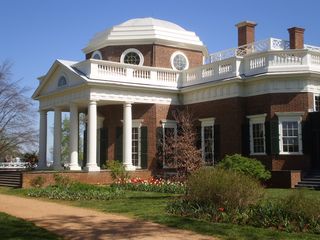
 In honor of Thomas Jefferson's birthday (which would have passed right by me had Kim Forde-Mazrui not mentioned this earlier in the week), I thought I'd post a picture of Monticello that I took recently.
Couple of thoughts about Monticello — it's, unsurprisingly, in an absolutely beautiful setting. But what I guess I'd never really focused fully on is how much it was the center of a plantation as well as Jefferson's home. I don't know why I didn't realize this — and looking back on Annette Gordon Reed's The Hemmingses of Monticello that should have been clear to me. But this reminds me of the importance of actually visiting a place to get a better sense of it. There really is something important that is conveyed by place, as well as by book.
Jefferson had all manner of gadgets — a dumb waiter that brought wine up to the dinning room from the cellar; a clock that told the day as well as the hour; a camera obscura. There was something about him that reminded me of Doc Brown from Back to the Future.
 I took a bunch of the tours — the house tour, the garden tour, and what was for me the best part of the visit, the slavery tour. First, though, a little bit about the house tour — our guide had an answer for every question it seemed and he said, if you ask something I don't know the answer to, we'll get right to researching it and probably have an answer before you leave. I thought that a very strange way to begin the tour — but someone (not me, I promise you, it wasn't me) asked — get this — who the executors of Jefferson's estate were. And so as we walked through the house one researcher stopped by to whisper in our guide's ear that whoever — name meant nothing to me — was the primary executor, but several other people served as well and that they would have the other names shortly. Which, of course, they did. Then someone else asked about a mirror and our guide said, I don't know the provenance. But as we walked into the next room he called for the inventory of the room where the mirror was; shortly afterwards a three ring binder appeared and he was able to tell us about the date the mirror was acquired and a few other details. Sort of like a human wikipedia.
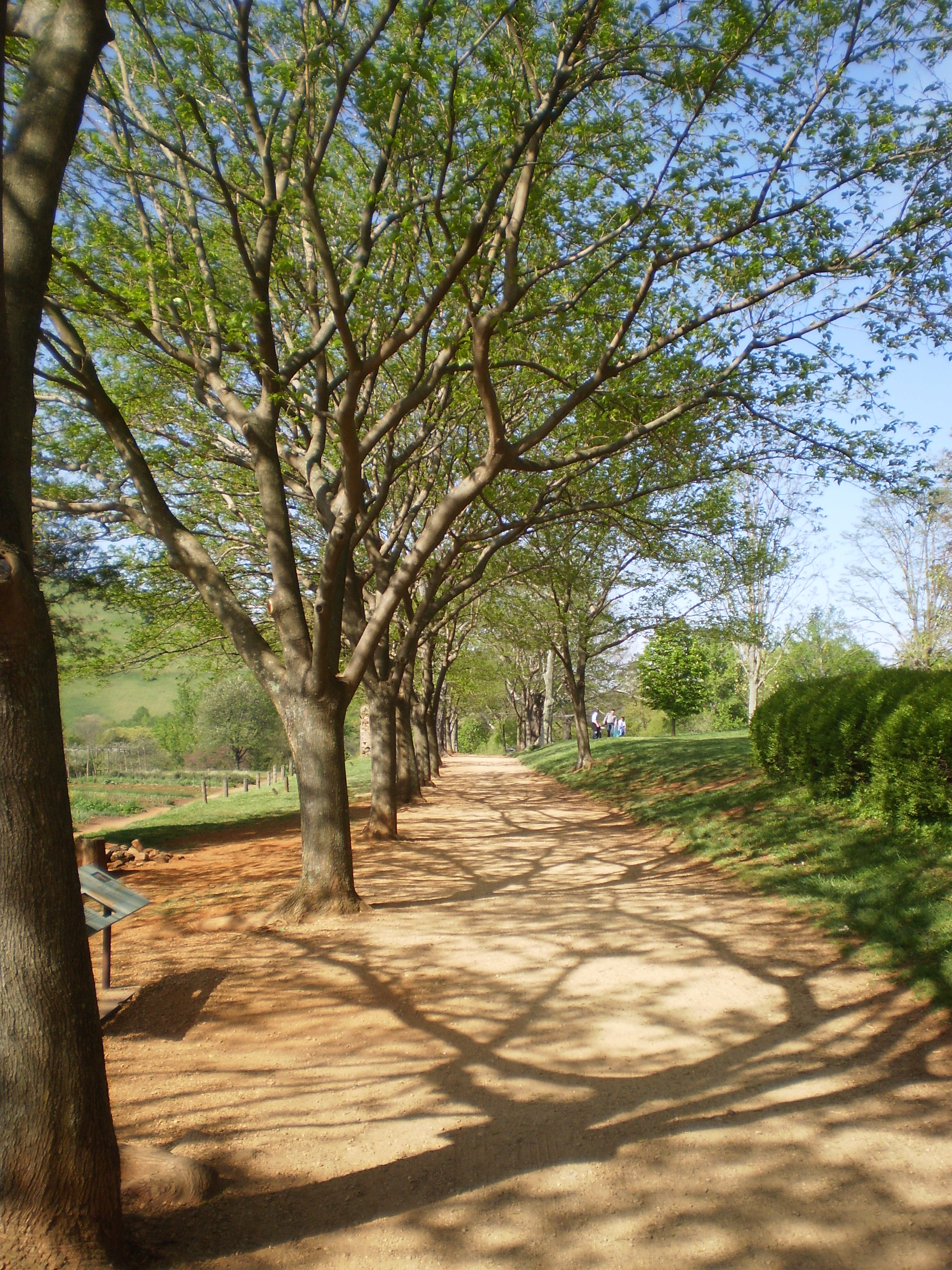
Now, as to the slavery tour. I thoroughly enjoyed this — it was all outside; we walked along "Mulberry Row," which is where the buildings where the slaves worked once stood. (Given the discussion in the comments about "Mulberry Row," I've added a picture I took of it, at right. You can barely see the remains of a stone chimney near the rear of the picture, just to the left of the Mulberry trees.) All very exciting. Quite a nice way to spend Easter — a rival to Easter on the Aiea Loop Trail back in 2006. I must say that next time — whenever that is — I'm going to spring for the behind the scenes tour.
Monticello is embarking on an ambitious plan to reinterpret Mulberry Row, where the enslaved people who worked in the house lived and which was the site of, among other things, the blacksmith shop. The tours will be even more informative.
I'm delighted to hear this — the guide on the slavery tour said something along the lines of they're thinking (or maybe planning) on reconstructing some of the buildings along Mulberry Row. I didn't fully understand what he was saying. I thought the entire experience was really fabulous and I'd love to see a reconstructed blacksmith shop.
I was there a week ago. I was interested in the role the archeological work is playing in supplementing Jefferson's written records. For example, unearthed artifacts show that over time slave quarters were set farther apart from each other and from the overseers' house–suggesting growing independence of slaves.
The concern has been over the years, expressed by some visitors, is that the lack of a physical representation of a dwelling tends to "disappear" enslaved people.I never had a problem with just showing the contours of the living space, and talking about how many people lived there. But, to each his own. The guides are fantastic. I like the name change from "Plantation Community Tours" to "Slavery at Monticello Tours".
Archaeology is key. I remember insisting that there must have been more buildings on the mountain than TJ's records indicated on a plat he prepared when he was going to apply for insurance in 1796. Despite what he put down, it made no sense that there were not more buildings. Sure enough, just before THOM went to press, the digs found additional dwellings. Written records do not tell everything.