

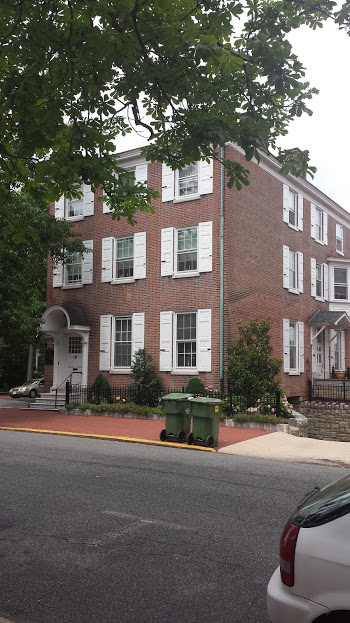
 I've made a practice for the past few years of a July Fourth trivia question or post related to Civil Rights. There was the Edmund Pettus Bridge a while back; and last year I wrote about Bayard Rustin. This year I want to ask a July Fourth trivia question related to fugitive slaves. I think Steven Lubet will like this one. It's tough, for sure. At right is a picture of a house of a pre-Civil War judge. (This is in a northern state.) An alleged fugitive slave was taken to the judge's house in hopes that the judge would issue a warrant for her return. While at the house, the slave escaped from the magistrate, perhaps with the help of the judge's wife. (Which makes this sound rather much like Stowe's vignette about Senator Byrd and his wife.) With a little more help from some other women nearby, she — it is supposed — made her way out of the county and onward toward Canada. (Or maybe she just moved a short distance away — who knows. But at any rate, she escaped. Or so the story goes.)
I must confess that I had not heard this story until recently; and the judge is pretty obscure, though I see that he does make a cameo appearance in Morton Horwitz' Transformation of American Law (on an issue of commercial law, not slavery). And the judge's son was killed in the War and is buried in the (no surprise here) rural cemetery nearby. Good luck with this one; I think it's going to be very hard to figure this out — because the judge is so obscure and so is the story of the escape. But I'd also add because even if you narrow this down, I don't know as there are a ton of pictures of this house on the net. There's no historical marker about this house, though probably there should be.
There is, however, a historical marker in the house next to this — and when I was taking this picture another couple was taking a picture of the neighboring house (where an important American composer once lived). We had a discussion about our competing reasons for taking pictures; and the man wondered whether "my" building actually went back to before the Civil War. I had to admit that it looked rather large for that early, but that I thought there was a decent chance this went back that far. And some further sleuthing on the web reveals that the house was built about 1829. The couple also expressed some skepticism of whether the story was correct — they were really quite an interesting pair. I have to confess that I'm somewhat suspicious of the story; this needs some further corroboration. But let's just say that there's an entrenched rumor that a fugitive slave escaped from this house.
Happy Fourth of July to you! I'm going to go back into my room to do some writing; with some luck there'll be something to talk about soon with regard to trusts and slavery, and certainly trusts and estates pedagogy.
I appreciate it very much, but I don't know the answer. City appears to be Philadelphia, however.
You have the state right, Steve. Distinctive Pennsylvania architecture, isn't it? Not quite Philly, though. I'm pretty sure you haven't written about either this case or this judge. But I think you're written about this county.
It's the home of Judge Thomas S. Bell at 101 S. Church Street, West Chester, PA.
I think it's the house referenced here, next to Samuel Barber's house in West Chester, PA:
839
Under the Fugitive Slave Act, Rachel Harris is arrested by bounty hunters and taken before Judge Thomas Bell at his quarters which still stand at the southeast corner of Miner and Church Streets. Before he can review all the evidence to consider whether she is a runaway slave to be returned to her southern master, she escapes, with the help of the judge's wife, Keziah, by scaling a seven-foot fence on the way to the out-house. Finding a hiding place in a neighbor's attic, she is disguised as a man and both Rachel and Isaac are transported along the Underground Railroad to Canada by local abolitionist Benjamin Price where they make a new life.
Enjoy these hunts on the holidays.
Best
Steve
Holy smokes you guys are good. How the heck did you do this? There are virtually no photos of this place on the net. Jason and Steve have both gotten to the bottom of this.
Judge Thomas Bell later served on the Pennsylvania Supreme Court (which is why Horwitz was talking about him). Bell's son was a Lt. Colonel during the Civil War and died at Antietam. The son is buried — along with the Judge and his mother — at Oaklands Cemetery, just outside of West Chester. I need to get a picture of their graves next time I'm there. There are a number of Civil War veterans buried there.
I also want to do a little more investigation of this story — like figuring out if there is any contemporary corroboration of this story (the version we have was published I think in the 1880s).
Happy Fourth to everyone!
Rachel, Keziah, Issac, and Benjamin are heroines and heros, indeed. Thank you for this golden thread of history to remember freedom by. Happy 4th of July!