

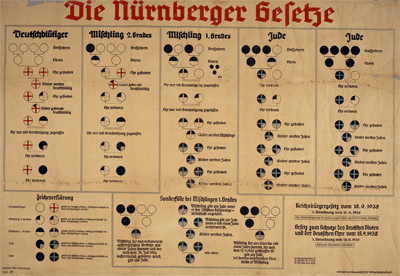
 Yes, a genuine Nazi. And therein lies a story.
I have completed now my twenty third year in teaching, which because of some family health issues has been a tough one. I promise I will get to the projects that I owe and am behind on, and believe me there are many. As a way of getting back to writing and my other obligations, I took a break and read James Whitman's fabulous new book Hitler's American Model. It explores the Nazis' use of American precedents on race laws. There's a lot to say about it; I'd like to focus here on the fact that Whitman's book is much, much more about how Nazis thought about the US than about what the law in the US was, or whether there was some causation or "transplantation" from the southern US states to the Nazis. The Nazis were plenty capable of coming up with vicious race laws all by themselves — but this is largely the story of how Nazi lawyers interpreted and spoke about the US' history of conquering Native Americans and then segregating African Americans. (There was, of course, criticism by the Nazis of the breakdown of the strict line separating the races in the US.) If this had been written in the 1950s, at the height of the myth and symbol school of American studies, it would have been called something like "The image of southern US law in the Nazi legal mind." Let me say to legal historians, you really need to read this book, soon. As I told a colleague this afternoon, this is the best book I've read in legal history in years, in large part I think because it seems so fresh. I've read books that are deeper but none in recent years that seem so original and iconoclastic.
I've been obsessed with the Nazis of late (probably like a lot of readers). Though I guess my interest in this goes back to the day as as a graduate student when I watched a bunch of Nazi era films at the Harvard film archives. How, I continue to wonder, did the person who wrote and starred in Das Blaue Licht become a leading filmmaker for the Nazis? I mean, my god, isn't that all about unjust persecution? Did Leni Riefenstahl ever consider in her later years what her younger self (who wrote about the persecution of the witch) would have thought of the Nazis? Maybe not. I guess that's how self-delusion works.
To return to my story, Whitman talks about a lot of things that are of interest to American legal historians, especially how the Nazis had a form of legal realism. This will cause me to rewrite at least somewhat my essay on Karl Llewellyn's lost work against lynching. But one of the more astonishing insights of many in Whitman's book is that Heinrich Krieger, who published a major study of the American race laws in 1936 also published an article, on Native Americans in the George Washington University Law Review in 1935. Holy cow. (And here I am thinking that the defense of the Confederacy and the constitutional vision of the pre-Civil War south in the Yale Law Journal in 1921 was bad). To be fair, Krieger's article is really about how the Constitution does not quite cover the category of dependent citizenship that had been assigned to Native Americans. If you didn't know Krieger was a Nazi lawyer, you wouldn't get that sense from this article, with maybe a few asides (such as a remark about the degeneration of Native Americans at 284). Though there are some other places where he seems to doubt the wisdom of recognizing that Native Americans have the same rights as other citizens. (at 307-08.) (And if you're interested in reading Krieger's book I've scanned it in here.)
I'm going to spend some time thinking all of this through, though I'm really slow at reading German these days, so this is going to be a long-term project for me. What interests me most about this book is the legal theory and how American law looks through the eyes of the Nazis. And how the Nazi perspective aligns — or not — with how we now think about the US' long history with race. One comment stuck with me from Whitman — that the Nazis complained that the Americans tried to hide some of their grosser race laws.
surely, you don't believe that the treatment of the native peoples of North America was led by "the South." Please tell me you didn't suggest that there is an issue, with respect to such treatment about "whether there was some causation or "transplantation" from the SOUTHERN US states to the Nazis" … you didn't mean to suggest that the treatment of native peoples by the United States was "The image of SOUTHERN US law in the Nazi legal mind."
To be sure, the Nazis used the genocide against the native peoples of America as a model for their actions. But, any suggestion that the treatment of these native peoples of America was a function mainly, or even in principle part motivated, by the "SOUTHERN US states" would be not only wrong and ahistorical, but stunningly wrong.
I'm sure you didn't mean to suggest any such thing.
Krieger's book is — as I understand from Whitman, I have asked for it from remote storage and it hasn't arrived yet — largely about southern US race laws. It is largely about African Americans but I think there's also something' about Asian Americans and maybe Native Americans, too, in it. But the focus of the Nazis was largely on segregation in the south (and anti-miscegenation laws that went beyond the south). They also looked to the treatment of Native Americans.
One vignette of Whitman's book that I didn't mention is that some Nazi lawyer cited John Calhoun's writing about racial hierarchy favorably. That vignette aside, slavery occupies a smaller part of the story than I would have expected. They were mostly interested in the contemporary US.
Krieger's article, which I link to above, isn't focused on one region. It's general. A key point is that the US Constitution isn't broad enough to permit federal government to regulate Native Americans the way they have been and ought to be regulated, as guardians of the government. The racism in that article is more subtle, which explains why this hasn't received a ton of attention yet, I should imagine.
On further reflection this morning, I'd like to add that a lot of the mistreatment of Native Americans took place in southern states, though this is now starting to be a discussion of issues far afield from Whitman's book.
I should also add that I think this is going to be a book that we talk about for a very long time — and that it'll inspire a whole lot of other scholarship (partly on jurisprudence, like comparative legal realism, and I think also on the substantive law of race in the US in the 1920s & 1930s).
Since I am respectable gentleman of impeccable tastes, qualities, professionalism, integrity and academic credentials, I would never ever share with the world what came to my mind when I initially read the title of this post…. Never mind, HE probably can't write anyway.
Al,
I'm willing to be corrected, but in the back of my mind lurks a detail that many of the early states' race laws including southern states' laws treated "indians," i.e., native Americans in broadly similar ways to those of black/African ancestry. Moreover, Spanish America also had such a system which was adopted in the south, and specifically considered Native American as well as African ancestry: peninsulare (both parents plus born in `the Iberian peninsula), Criollo (pure Iberian descent), another for one penisulare parent and one European, metizo (one European plus one Native American parent), mulatto (one Iberian/European and one black/African), etc.
Read a little Mark Twain and you'll see copious derogatory references to [half]-breeds like say "Injun Joe" whose inherently evil character is ascribed to his "Indian" ancestry – which goes to say that Twain, progressive in so many ways, was pretty nasty and backwards when it came to miscegenation and native-Americans.