

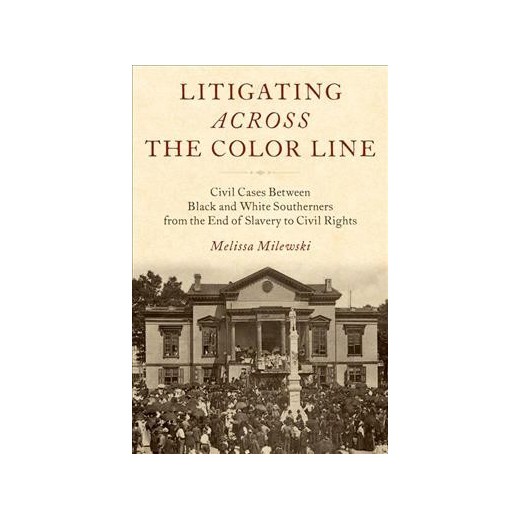
 Let's start the new year off right … by talking about some recent, outstanding scholarship. I've been reading Melissa Milewski's Litigating Across the Color Line. Close followers of happenings in legal history may have seen Milewski's posts over at legal history blog in November or have read her article, "Rethinking the Role of the Courts in the Lives of Black Southerners," in the Organization of American Historians' magazine, The American Historian. Cribbing now the description of the book from OUP's website:
This is an incredibly important book, one of the most significant works of legal history I have read in a long time. It brings much needed nuance to the legal history of Jim Crow. It may also show something of why African Americans placed some faith in the legal system — when, for instance, in the wake of the Tulsa riot one African American newspaper editor in Oklahoma City urged those who had lost their homes to turn to the federal courts for relief. (They lost there, when they did file suit.) And the research is prodigious. This is a book that will be taken very seriously and will inspire a lot of follow-up studies. This follows on other work that discusses the legal rights of enslaved people and also free people before the Civil War. Those books have made big waves in legal history of the pre-Civil War south. They include Lea Vandervelde's Freedom Songs about the freedom suits pre-Dred Scott in St. Louis (which I discuss extensively in "Slaves as Plaintiff") and Kirt von Daacke's Freedom Has a Face, which is about free people of African descent in Charlottesville.
Milewski is likely to have an even bigger impact than those books because she's the first to be extending those questions into the Jim Crow legal system. There have, to be sure, been other scholars of the Jim Crow system who have found exciting and surprising activism among African Americans. Glenda Gilmore's Gender and Jim Crow comes to immediately to mind. Gilmore shows the vibrant and previously forgotten activism of African American women. (My own Reconstructing the Dreamland, identifies the vibrant ideas about equality in circulation in the African American community in Tulsa in the 1910s and very early 1920s.) What those books have not done, however, is to link the ideas and activism in the African American community with significant success in the depths of Jim Crow. They have seen a division, largely, between the African American actors at the center of their studies and the political and legal system. DuBois is a person who critiques Jim Crow and leads the way for future success, but there has been little emphasis on the successes. Instead, work on Jim Crow has emphasized its brutality and effectiveness in enforcing white supremacy.
Thus, Milewski looks closely at appellate cases and sees a surprising amount of success among African American plaintiffs. There was more opportunity to be heard than we have expected. More than expected — that's the key, of course. I always marvel at the fact that any African American person escaped slavery through freedom suits — that there was any success is extraordinary.
I want to sketch a couple of thoughts here because I hope to write substantially more about this in a law review down the road. These are appellate cases that are decided within the already titled playing field of common and statutory law. Thus, for instance, the right to sue on an employment contract was already limited by the doctrine that required full performance of the contract. Or, in the case of Tulsa, by a substantive law that sharply limited the right to sue the government. Therefore, Milewski is showing what was possible given the rules already stacked against African American litigants. Similarly, this is not a study of the multiple ways that juries and judges could exercise prejudices against African American litigants at trial. There is some relief, in particular, when African American litigants appear as humble supplicants. Milewski discusses cases of fraud, where African Americans who portray themselves as unsophisticated in commercial matters (and thus fit the stereotypes of white supremacy) sometimes receive relief. And she also has a chapter on civil rights cases, where again sometimes there was relief. Buchanan v. Warley is one her key cases. Things got better, especially after 1933, for civil rights plaintiffs. So part of this is the story of increasing African American political participation. But Milewski opens up room for debate about the fairness of the appellate legal system.
Reading this book gives me a sense of what it must have been like to read Robert Cover's Justice Accused or Morton Horwitz' Transformation of American Law, 1780-1860. For Litigating Across the Color Line is a book that robustly challenges a lot of accepted wisdom, and also invites a lot more research in response.