

I'm finishing up reviewing page proofs for a new Estate & Gift Taxation casebook, co-authored with the excellent Wendy Gerzog (Baltimore) and Joseph Dodge (FSU), to be published by Aspen this spring. While reviewing pages, my co-authors and I also put the finishing touches on our Teacher's Manual and it's almost ready to fly.
Prior to beginning work on the Teacher's Manual all-those-months-ago, Aspen had solicited feedback from outside reviewers (who remained anonymous to us authors). The reviewers all said the same thing: The book is great, but adoption will depend largely on the quality of the Teacher's Manual. In a follow-up post, I'll reveal what the reviewers thought made for a "good" Teacher's Manual, but in the meantime, offer up your view by participating in this poll.
What makes for a good Teacher's Manual, however you define it? Here are the choices.
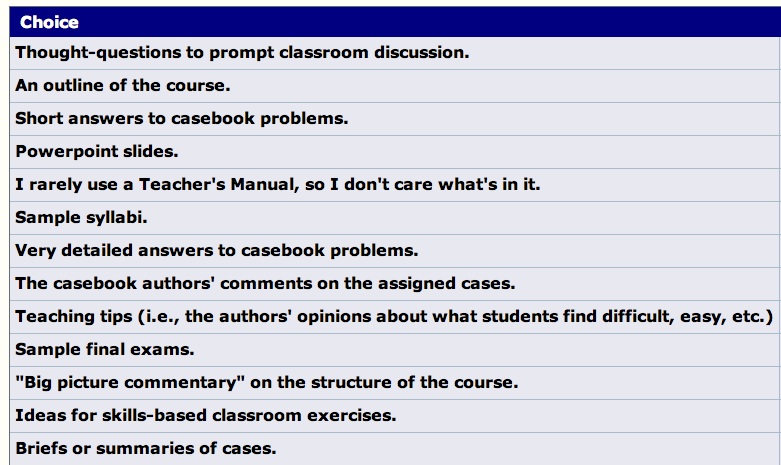
Vote here. Polling open until February 16 at noon.
Thanks for putting this poll together — I look forward to the results. As I was taking the poll, it occurred to me that how I ranked some of the items might depend on whether I am using choosing a book for a new prep as opposed to a course I have taught many times before. For example, I love seeing sample syllabi for a new prep, but I rarely look at them for a course I've taught for years. Ditto for a course overview or outline. As a result, something like sample syllabi might be very important to a subset of potential adopters, but get ranked in the middle (on average) because another subset doesn't value them.
A couple suggestions:
1) Avoid tiny type, assuming you have any control over this. There's a Thomson book whose teacher's manual uses such small type that it's virtually unreadable. Lexis is generally much better about publishing teacher manual's or normal sized paper — I started using mostly Thomson/West books, but now almost exclusively use Lexis books.
2) If your casebook employs Problems, then *please* reproduce both the questions and the answers in the teacher's supplement. Again, the trend with Thomson/West is to reproduce only the answers, whereas Lexis reproduces both the questions and the answer. I moved form West's leading Fed Tax Book to one published by Lexis mostly for this reason.
Wow, am I out of step with the mainstream (but I suspected that). What I want more than anything else is a sample syllabus. Guessing how long things take, and especially figuring out what can safely be skipped, are for me the hardest thing to predict when using a new book.
The rest I can usually do myself, although sometimes, for an obscure question in the notes, it can be helpful to be told what the authors were trying to get at.
If a Casebook is in a new edition, one of the things I wish were in the teachers' manual is an explanation of what changes the authors made and why. I'm not talking here about subbing in a new case for an old case, so much as the rationales for reorganizing topics or changing emphases.
Every brave man is a man of his word