

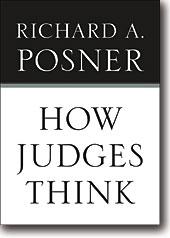
 Something that hasn't gotten the attention it deserves in the blogosphere is the conversation that Richard Posner had with a Duke Law School class led by David Levi and Mitu Gulati. The Duke Law Journal has recently printed it. The conversation covers a lot of ground (like Posner's shifting political orientation and the confirmation hearing for Chief Justice Roberts — notable for Posner's amusing lines, "The senators have staff who prepare tough questions for the nominees. But the senators don’t know how to follow up on the question that someone else created. The result is that if you are adept like Roberts, you can get away with not answering the question. He got away with saying things like that stuff about balls and strikes."). The conversation is mostly focused around Posner's book, How Judges Think.
But the criticism of opinions is not terribly useful. Judges don’t pay a lot of attention to these critiques. They don’t think law professors are giving them much in the way of useful, constructive criticism. And it is not that useful to be looking backwards at errors in past opinions. By the time a judge reads a law review article criticizing or analyzing an opinion of his, it is likely that a lot of time has gone by since the opinion was written. Happy judges don’t want to look back at their mistakes.
We hear about the vagaries of the evolution of the law, how tests and metaphors emerge by almost happenstance:
I had a case that involved bits and pieces of evidence of discrimination. I talked about the “mosaic of discrimination.” Years later, I realized that a “mosaic” rule had emerged. But that was ridiculous. You don’t need a mosaic. Judges love clichés. They are always grasping at clichés.
Today, the leading academics do not see intellectual profit in writing a treatise or a restatement. Today, cutting-edge law articles use social science. They draw from fields like psychology, economics, et cetera. They don’t work with doctrine as much. Much of the current academic publishing ends up being too academic and esoteric. As for the restatements and treatises today, they are competent. But the work of producing them is not engaging the leading academics any longer.
The interview is really entertaining; Judge Posner has some great turns of phrases. Let me, though, highlight a couple of things that are perhaps of particular interest to legal historians. When I first read How Judges Think, I wondered, does it also describe "how judges thought?" That is, is there something to the American judicial method that's fairly stable across time?
One of the things that Posner suggests is that studies of judicial biography are good ways of getting at how judges think (or thought). That's obviously correct — if we want to see how the whole world fits together, looking at how the world fits together within one individual is a great way of going about it. Jurisprudential biographies are the way to go — looking to how judges' ideas fit together; I'm not so sure we need so much of their more personal details. (Of course, we then need to put together a series of those studies, to get a sense of what's idiosyncratic to one judge and what's stable across a bunch of them). He says:
I thought something like my book on Cardozo was more useful as a way of studying judicial behavior than full-length biographies, but the suggestion hasn’t been picked up. Andy Kaufman’s biography of Cardozo, though lengthy, is the best of the judicial biographies. Bruce Murphy’s biography of Douglas is also good, though it has inaccuracies. I published an article on judicial biography some years ago, Judicial Biography, that you might find useful.