

Continuing in the series that Melissa Jacoby and Mirya Holman are writing on their recent paper, Managing Medical Bills on the Brink of Bankruptcy:
We’re back again on Managing
Medical Bills on the Brink of Bankruptcy. Yesterday we talked about the
political and policy context. The health
care finance reform debates have reignited the disputes over the measurement of
medical bankruptcy. Today we’ll show
some results applying the two contested approaches (survey questions on out-of-pocket
medical expense within two years of filing and court records of debt owed at
the time of filing that debtors submit) to the same sample. Bottom line: court records may be useful to assess
the burden of patients’ bankruptcies on health
care providers, but we have concerns about the accuracy of the court record
approach to gauge the burden of medical bills on patients and their families. On the other hand, combining the approaches
offers a richer picture of the dynamics of the relationship between providers
and their financially-distressed patients.
Look at the overall simple distribution
of the two measures in figure 2 from the paper below.
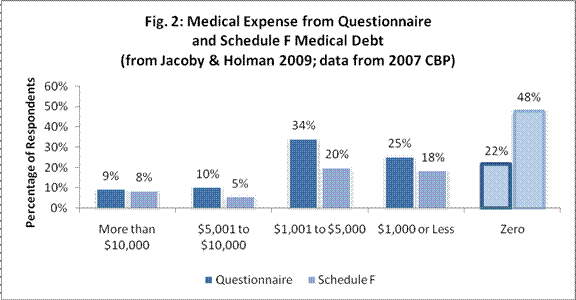
From figure 2, we can see very
different patterns revealed by survey data and court records. In the court records, positive indications of
medical expense shrunk, while the “zero” medical bill category grew. Not much visible decline in the top category,
but bear in mind that this is an open-ended category that includes some debts
in the hundreds of thousands of dollars.
Why do we see these differences? Credit cards are a popular explanation, but we
could not presume it explained the lack of congruence. For example, maybe people paid off the bills
with cash before filing and thus no longer owed any debt. Or maybe filers forgot to list medical
providers on their bankruptcy filings.
To address these questions, we
did filer-by-filer comparisons of the two measures. We were able to test these hypotheses in part
because our study asked all respondents
how they dealt with recent out-of-pocket medical expense, not just respondents
who indicated medical burden as many studies do.
About a fifth of our sample reported
at least $1,000 more in
pre-bankruptcy medical bills on the survey than could be found as medical debt in
court records; within this group, many cases had a “discrepancy” between these
measures bigger than $5,000 or $10,000. (Note
that this is not a comprehensive
count of medical burden; for example, some people had over $10,000 of medical
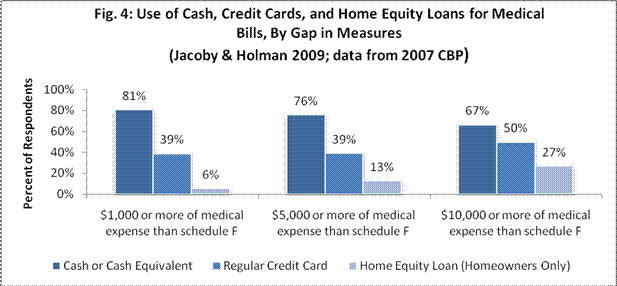
bills by both measures). Figure 4 shows some
of the ways such filers managed medical bills.
As indicated earlier, one explanation for the incongruence between the
measures might be that filers simply paid off their medical debt. However,
figure 4 shows that the likelihood of using credit cards grew as the gap
between the two measures increased, while the use of cash did not. Filers with bigger gaps between the measures
also had larger general credit card debts in their court files (figure 5 in the
paper).
And check out the percentage of homeowners who report using home equity
loans to pay their medical bills – the right-most column in each cluster in
figure 4. As an aside, home equity
loans usually survive bankruptcy, meaning generally that the lender must be
paid in full or the debtor will lose the house. Plus, homestead exemptions protect debtors
from regular medical bills and credit card debts, but not from home equity
lenders. But again, using home equity loans for medical
debts make those medical debts disappear from standard court record studies.
As further evidence that the shifting of medical bills to credit
products leads to a particularly distorted picture from court record studies,
we report in the paper (figure 3) that people who report medical bills as a
reason for filing bankruptcy also report credit card and home equity use at a
much higher rate than other debtors. Whatever
the reason, the obligations are hidden more frequently in court files of those debtors
who had faced significant medical bill problems. And, as figure 6 below displays, people with
the largest gaps between the measures have the highest rate of medical bill
reasons for bankruptcy by far – the baseline rate of reporting a medical bill reason for bankruptcy when asked
why they filed on the questionnaire was 29%.
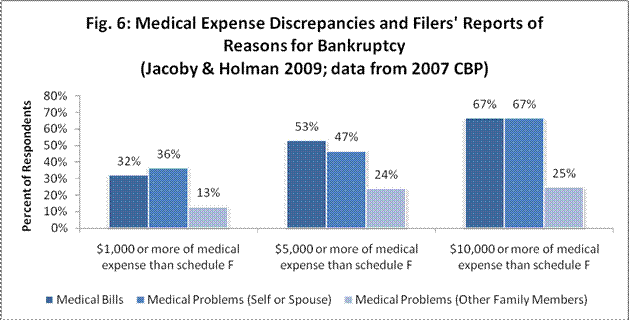
To be clear – two-thirds of
people with more than $10,000 in medical expenses but no medical debt on schedule F that they submitted into the court
records reported that medical bills were a reason they filed for bankruptcy. They are invisible in a court record study.
As mentioned at the outset, court
records may help us understand the burden of bankruptcy on health care providers
who remain creditors in these cases, but they produce a significant undercount
of the burden of medical debts on patients and their families. In discussions of health care finance reform
or bankruptcy reform, members of Congress and academics should not try to
debunk survey studies of filers’ medical hardship with court record analysis.
Our study has implications for
health care finance and bankruptcy more generally. We’ll talk about that next time. Thanks for reading.