

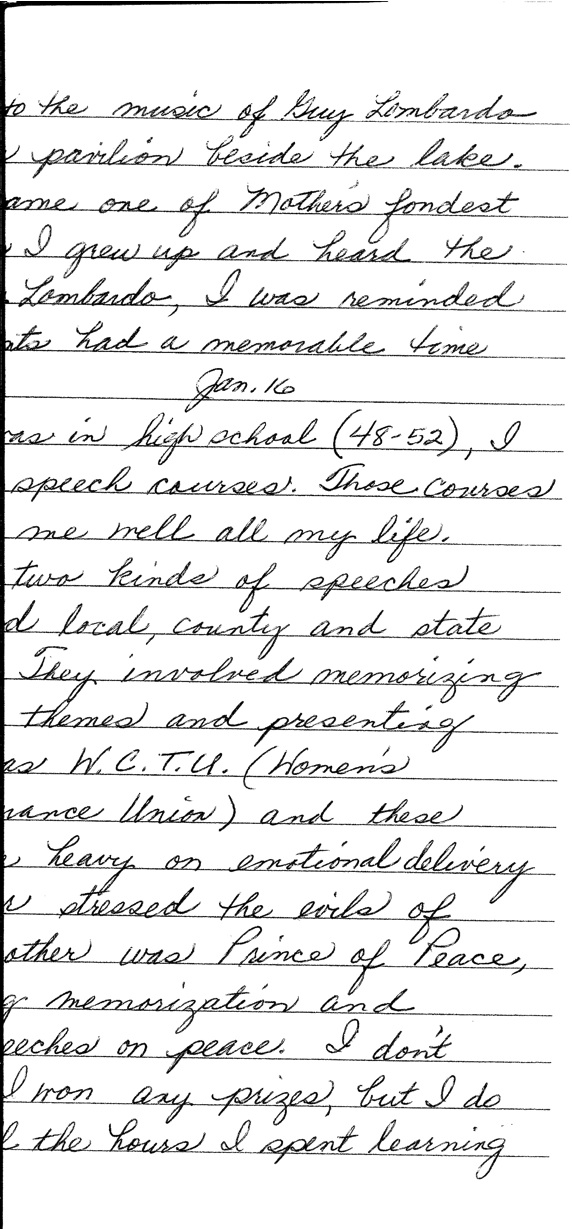
 My Aunt Jody has the neatest handwriting of anyone I know. When I was growing up in the 1970's, any day I received a letter from Aunt Jody was like a holiday to me. First, receiving a letter back then was a very exciting thing. As a young child, I was fascinated by the mechanics of a postal system that could deliver a letter from her hometown in southern Ohio to my home in the suburbs of Cleveland. The multiple steps involved in mail delivery were the source of much wonderment in my my young mind. The other special thing about receiving a letter from Aunt Jody was that she wrote in cursive. I felt so grown up when, at 4 or 5 years old, I could understand adult handwriting. Aunt Jody's script was and is beautiful and precise (true sample at right). To this day, she has the best penmanship anyone in my family.
Today, my fond thoughts of Aunt Jody's beautiful script are inspired by the hours I spent hunkered down with my students' bluebooks. I have just begun grading the exams for my Trusts & Estates course. In a class of about 90 students, approximately 75% elected to use the school-provided software for writing exams on computer. (My school now uses Exam4 by Extegrity.) Approximately 25% of my students wrote their exams long-hand. This semester I was struck by the number of students in that latter group who wrote in block letters or print, instead of in script/cursive. The New York Times has proclaimed (here) a downward trend in the number of young people who are skilled in the craft of cursive writing:
With computer keyboards and smartphones increasingly occupying young fingers, the gradual death of the fancier ABC’s is revealing some unforeseen challenges.
Might people who write only by printing — in block letters, or perhaps with a sloppy, squiggly signature — be more at risk for forgery? Is the development of a fine motor skill thwarted by an aversion to cursive handwriting? And what happens when young people who are not familiar with cursive have to read historical documents like the Constitution?
I must confess that I had never considered the research-related implications of a preference for cursive, but it makes sense. If one doesn't write much in script, one's "fluency" with it likely declines as well.
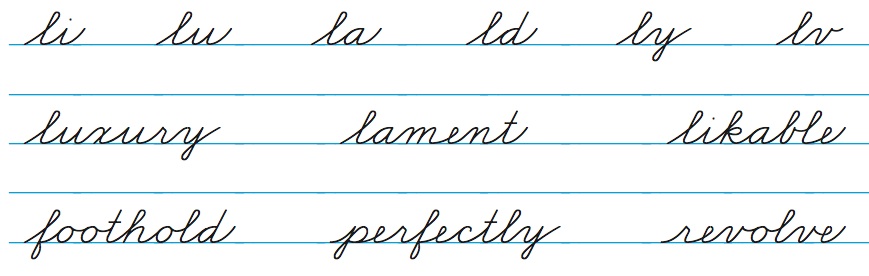
That being said, my guess is that proclamations the death of fluent handwriting are a generational refrain. As part of the licensing process to become an elementary school teacher in Ohio in the 1950's, Aunt Jody and other aspiring elementary school teachers took a required penmanship course. Teachers-to-be received weekly assignments by mail from the Zaner-Bloser company (originally the Zanerian College of Penmanship established in Columbus, Ohio in 1888). The teachers-to-be completed the assignments and then returned them to Zaner-Bloser for feedback and grading. Conformity to the standard style (sample immediately above) was the basis on which teachers-to-be were graded. Folks trained under that system no doubt lamented the inability of my generation to write in "proper" cursive.
It's true that my handwriting doesn't hold a candle to Aunt Jody's, but it's not that horrible either. And my students' handwriting is quite comprehensible. So, I won't join the "death of handwriting" chorus but I will praise Aunt Jody's neat script all the same.