

 Last year, I blogged
a few
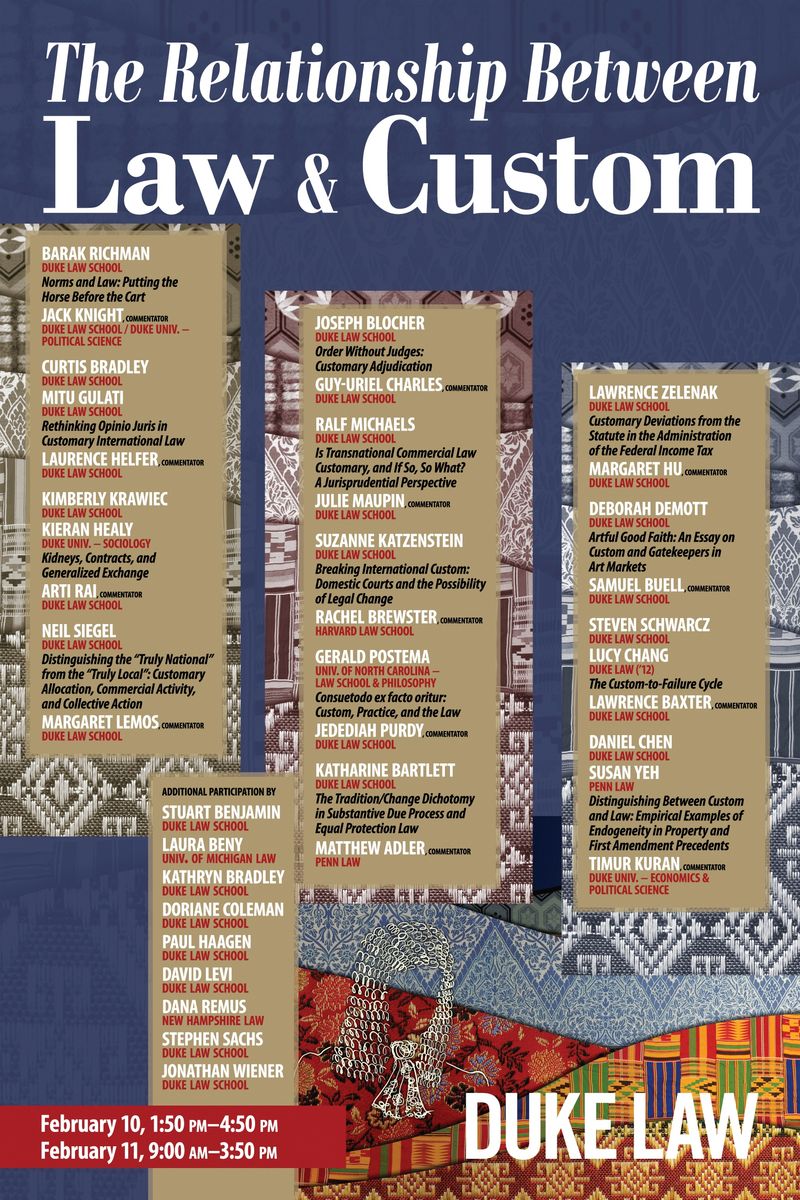
times about Duke’s year-long Custom and Law project, which culminated in a Duke
Law Journal symposium in February. Kieran
Healy and I presented a draft paper on nonsimultaneous, extended, altruistic
donor (NEAD) chains at the conference (with commentary by Arti Rai), which we
have just posted
to SSRN. Though I’m biased, of
course, I think that the paper is a neat addition to the relatively new, but
growing, research on NEAD chains, and does a pretty good job of critically
evaluating what we view as overly simplistic characterizations of NEAD chains
as either gifts (and thus good) or market exchange (bad in the minds of most,
though not all, observers).
In a NEAD chain, an altruistic donor freely gives a kidney
to a patient, initiating a chain of transplants among a series of donor-patient
pairs. Each donor has a kidney that is incompatible with “her” patient, so
instead each donates her kidney to the compatible patient of another
donor-patient pair, forming the next link in the chain. NEAD chains are a
relatively recent innovation in the transplant system, and they seem set to
become more common in the future.
In our paper, Kieran and I ask the question: What sort of
exchange is this? And, does it matter?
In some ways, a NEAD chain resembles a form of generalized
exchange, an ancient and widespread instance of the norm of reciprocity that
can be thought of simply as the obligation to “pay it forward” rather than the
obligation to reciprocate directly with the giver. Generalized exchange has
long been seen as an extremely effective customary means of generating
commitment and solidarity in social groups, because everyone participates in
the exchange of values.
This imagery of solidarity and collective commitment
generated through a chain of gifts has been important to the success of NEAD
chains. In particular, the presence of a gap in time between exchanges introduces
some standard elements of gift giving, especially the social obligation to
reciprocate (pay forward) and the problem of trust that arises along with it.
Looked at from a different point of view, though, a NEAD
chain is not like gift exchange at all. Instead, it resembles a string of
promises and commitments to deliver something in exchange for some valuable
consideration—in short, a series of contracts. After the first free donation,
each donor-patient dyad in the chain in effect promises to pay the donor’s
incompatible kidney forward upon receipt of a compatible kidney for the
patient. Isn’t this the essence of contract?
But Kieran and I argue that the attempt to starkly
categorize NEAD chains as either gift–with the attendant virtues of expressivity,
warmth, and social solidarity that are taken to flow from exchange built on
altruism and sharing—or contract, with the attendant self-interested,
price-driven, instrumental orientation
 associated with market-based exchange—is
misplaced. We emphasize that, although
both generalized exchange and formal contract can be thought of as culturally
available schemas for governing the exchange of kidneys in NEAD chains, both
are imperfect fits for the intricate realities of NEAD-chain exchange. Gift-
and contract-based exchange models do, however, provide a rich cultural
resource to participants and professionals seeking to frame the social meaning
of NEAD chains.
In the end, we conclude, both gift and contract have the
potential to act as schemas for NEAD exchange. Neither fit perfectly. Gift
exchange is the more familiar template associated with organ transplantation,
but contract also has the potential to symbolically frame NEAD exchange.
Despite being rejected as inappropriate by some organizational actors,
contract-like forms appear implicitly or explicitly at several points in the
NEAD donation-and-exchange process—not, we emphasize, because anyone expects to
legally enforce them, but rather, it seems, for their ability to powerfully
symbolize credible commitments by participants. Whether this symbolic use of
contract will continue to expand is an empirical question.
One result of the current cultural and legal ambiguity about
the nature of NEAD chains within this imaginary gift-market divide, we argue,
is that the actual operation of NEAD chains has, so far, tended to fall back
onto relatively simple forms of simultaneous direct exchange. Even in the much celebrated sixty-person
(thirty-donor) chain detailed
in the New York Times in February, only five links involved a
pay-it-forward delay of more than twenty- four hours. We suggest that if NEAD
chains are to realize their full promise of true large-scale, non-simultaneous,
extended exchange, these legal and cultural ambiguities will need to be
finessed in practice by the coordinating agencies and the participants
themselves.
You can download the full paper here, and
we welcome your feedback.
Top Image: People Magazine via Al Roth