

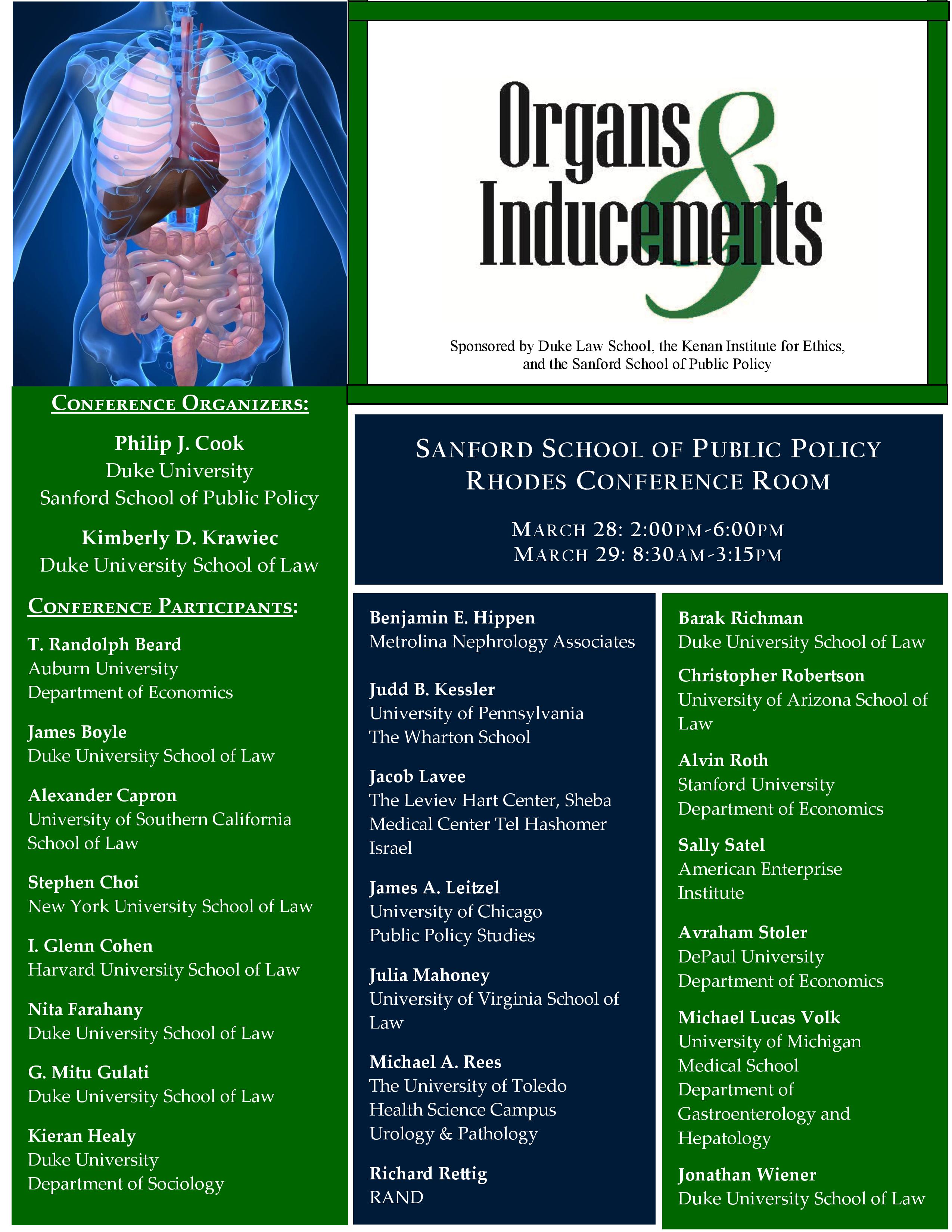
and attention last minute details would consume (what’s that phrase about older
but not wiser?). So I’m just getting to it now.
Anyway, I think that the event was a big success and I will
have more to say about it in the coming days.
For now, I’ll just post the symposium abstract, along with a thanks to
all the many wonderful participants who made this event a success.
More to follow . . .
Symposium Abstract:
The need for human organs for transplantation far outstrips
supply. As a result, a large literature has developed debating possible means
to address the gap. Suggestions range from procurement system improvements and
changes in the consent regime, in the case of cadaveric organ donation, to
inventive exchange systems (such as swaps and NEAD chains) and financial
incentives of various sorts, in the case of live organ donation.In Organs and
Inducements, contributors build on existing debates on mechanisms designed
to bridge the gap between organ demand and supply, to address deeper questions
regarding inducements to donate. Among
the varied possible mechanisms of persuasion and incentives at society’s
disposal, what are the relative advantages and disadvantages of each? What are the larger ethical, economic,
sociological, and psychological issues raised by these different types of inducements,
including non-financial inducements? Why
are some accepted by the law and society at large, while others are not? Do the lines we’ve drawn among permissible
and impermissible inducements make sense, given the concerns those rules are
meant to address?Related Posts: