

 I am delighted to report that the University of Pittsburgh Law Review has just published the papers from “Challenging Authority: A Symposium Honoring Derrick Bell.” The line-up is:
Jasmine B. Gonzales Rose Introduction PDF
Richard Delgado, Law’s Violence: Derrick Bell’s Next Article PDF
Jean Stefancic, Discerning Critical Moments: Lessons From the Life of Derrick Bell PDF
SpearIt, Economic Interest Convergence in Downsizing Imprisonment PDF
Stacey Marlise Gahagan and Alfred L. Brophy, Reading Professor Obama: Race and the American Constitutional Tradition PDF
Juan F. Perea, Doctrines of Delusion: How the History of the G.I. Bill and other Inconvenient Truths Undermine the Supreme Court’s Affirmative Action Jurisprudence PDF
George H. Taylor, The Object of Diversity PDF
Montré D. Carodine, Contemporary Issues In Critical Race Theory: The Implications Of Race As Character Evidence In Recent High-Profile Cases PDF
Patience A. Crowder, Interest Convergence as Transaction? PDF
Pat K. Chew, Challenging Authority PDF
Tribute Cheryl Nelson Butler, Sherrilyn Ifill, Suzette Malveaux, Margaret E. Montoya, Natsu Taylor Saito, Nareissa L. Smith, and Tanya Washington, The Story Behind a Letter in Support of Professor Derrick Bell PDF
Stacey Gahagan and I are honored to be part of that discussion. Our paper looks at (then Professor) Obama’s syllabus for his course on “current issues in racism and the law.” We were interested in what the reading he assigned and the topics he suggested for students to write on might say about his ideas on race, law, and constitutionalism. One of our big take-aways was that while he assigned a lot of Derrick Bell’s work (though not some of the most radical, such as the “space traders” short story) Obama had a more optimistic story about racism than Bell. A lot of the people he assigned wrote about racism’s mutability and the final line of the readings came from Cornell West’s New York Times Magazine article on the 1992 LA Riots: “Let us hope and pray that the vast intelligence, imagination, humor and courage in this country will not fail us. Either we learn a new language of empathy and compassion, or the fire this time will consume us all.”
We interpreted Obama’s concluding with West as subtly signalling Obama’s own ideas — certainly those themes appear in Obama’s later work, especially his 2008 Philadelphia speech, “A More Perfect Union.” One key theme that appears in Obama’s later work (and can be drawn from some of the readings here — though Obama never endorses them in the syllabus) is that racism is not necessarily permanent.
At some point I’d like to return to James Kloppenberg’s fabulous intellectual history, Reading Obama, to talk about how Kloppenberg interprets Obama as a constitutional historian. There is, as Kloppenberg says, a distinct vision of our Constitution’s history in Obama’s early writing. (Obviously we self-consciously titled our article as a riff on Kloppenberg — though where a lot of what Kloppenberg talks about is work that Obama read, our focus is work that he assigned for others to read.)
And I should add that I’m looking forward to welcoming Stacey back to the law school this fall, where she’ll be a visiting faculty member. This’ll give us a chance, perhaps to finally finish “Anti-Feudalism in American Property Law,” which we’ve been working on now for too many years. More on that — and on the attempts to re-establish vestiges feudalism in the Hudson River Valley in the eighteenth and nineteenth century (and maybe on Long Island in the early twentieth century) coming soon!
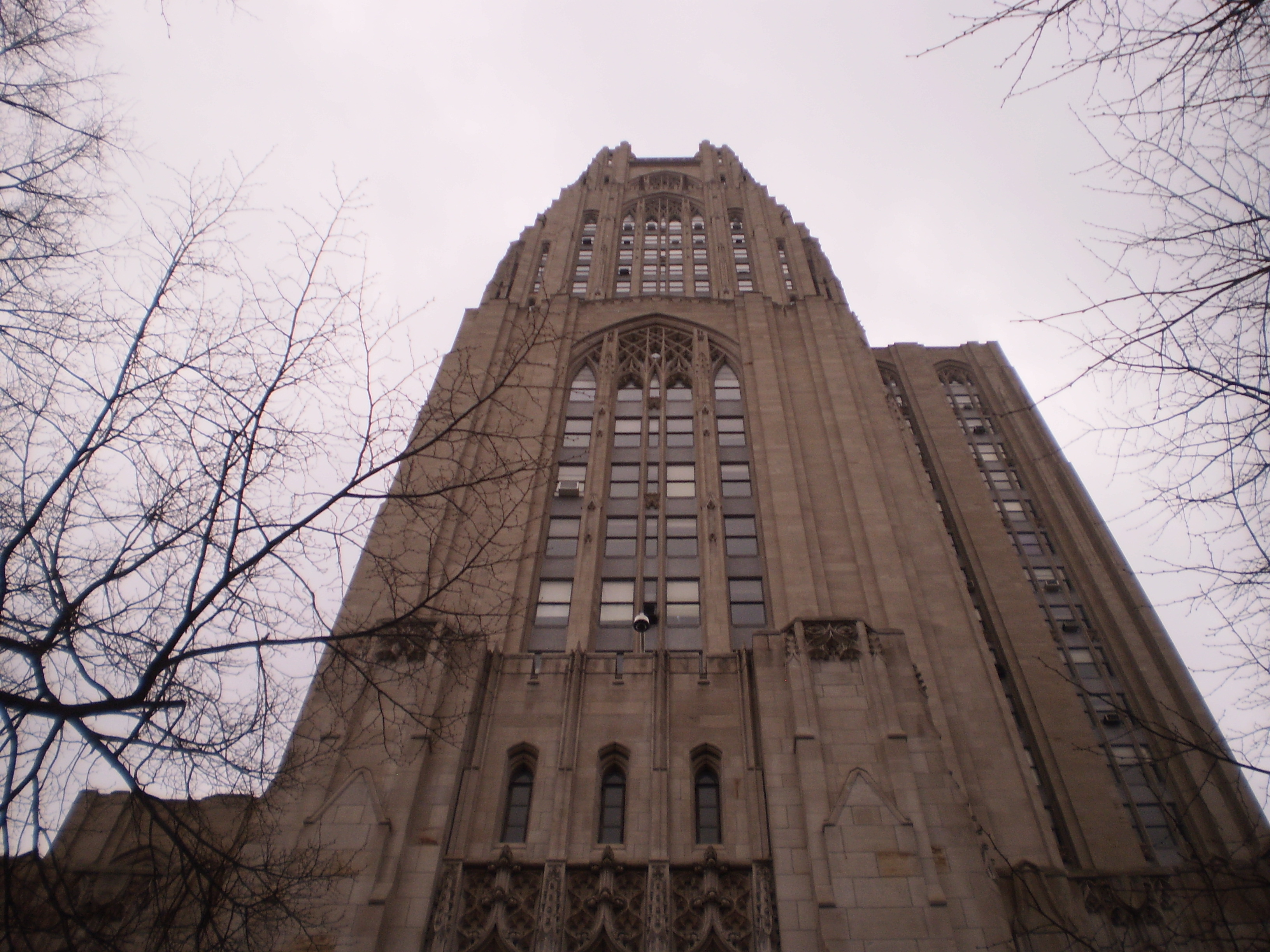
The illustration is the University of Pittsburgh’s Cathedral of Learning.